If you’ve spent any time around automotive refinishing, you’ve probably come across the terms 1K and 2K clear coat. They sound similar, but the difference between 1K and 2K paint matters a lot, especially when you’re deciding what goes on top of a freshly sprayed panel. At LENC Paints, we work closely with workshops and car enthusiasts across Malaysia, and this is one of the questions we get asked most often. So let’s break it down properly.
What Is 1K Clear Coat?
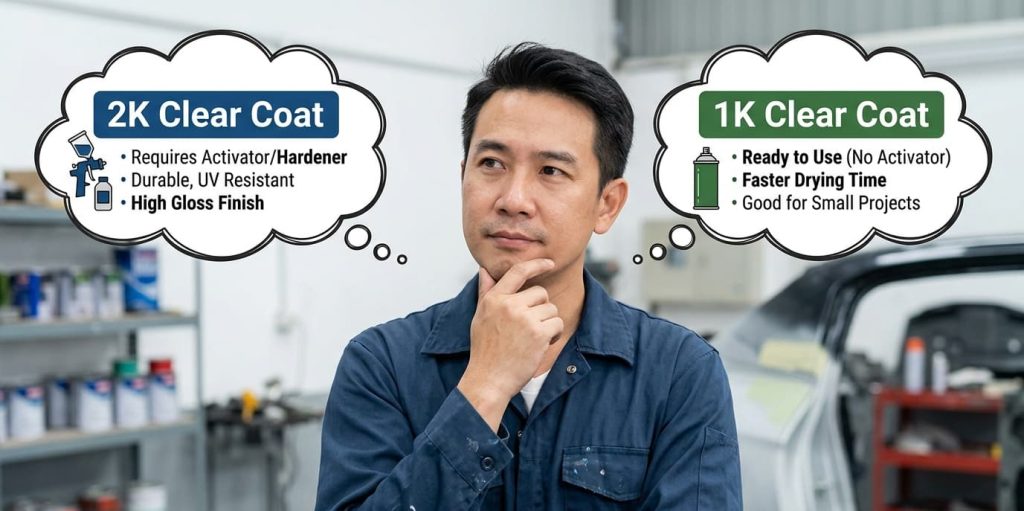
1K simply means single-component. There’s no mixing involved. You open the product, load it into your spray gun (or use it straight from an aerosol can), and you’re ready to go.
1K clear coat dries through solvent evaporation, meaning the solvents in the product escape into the air and leave behind a hardened film. It’s straightforward to use, which makes it a popular choice for DIY touch-ups, minor panel repairs, and situations where speed and convenience matter more than long-term durability.
That said, 1K has its limitations. The finish it produces is softer and more vulnerable to scratches, UV exposure, and chemical contact compared to its 2K counterpart. For anything beyond a quick spot repair, it starts to fall short.
What Is 2K Clear Coat?
2K means two-component. Before spraying, you mix the clear coat base with a hardener (also called an activator) at a specific ratio, typically 2:1 or 4:1 depending on the product. This isn’t just a procedural step. It triggers a chemical reaction called polyisocyanate cross-linking, which is what gives 2K its superior strength and durability.
Unlike 1K, which simply dries, 2K actually cures. That distinction is important. Curing creates a much harder, more stable film that bonds tightly to the substrate beneath it. The result is a finish that holds up significantly better over time.
One thing to keep in mind: once you mix a 2K product, the clock starts ticking. Every 2K clear coat has a pot life, a window within which the mixed product must be used before it begins to gel and become unusable. Plan your job accordingly before you mix.
If you’re looking for a reliable 2K option, our HALO 2K Clear Coats are formulated specifically for the demands of professional automotive refinishing.
Key Differences Between 2K Clear Coat vs 1K Clear Coat
Here’s a straightforward comparison to help clarify where each product stands:
- Mixing: 1K requires no mixing at all. 2K must be combined with a hardener at the correct ratio before use.
- Durability: 2K is significantly harder once cured. It resists scratches, marring, and general wear far better than 1K.
- Finish quality: 2K produces a deeper, more consistent gloss that holds its clarity over time. 1K finishes tend to look good initially but can dull faster.
- Chemical resistance: 2K stands up well to petrol, brake fluid, and harsh cleaning agents. 1K is much more vulnerable to these.
- Application: 1K is more forgiving, which makes it accessible for beginners. 2K requires proper spray equipment, good technique, and a controlled environment to get the best results.
- Drying vs curing: 1K dries through evaporation. 2K cures through a chemical reaction. This is the core reason 2K outperforms 1K in almost every durability metric.
| Feature | 1K Clear Coat | 2K Clear Coat |
|---|---|---|
| Mixing | No mixing required | Must be mixed with a hardener at the correct ratio |
| Durability | Softer and less resistant to scratches and wear | Much harder once cured and highly resistant to scratches and wear |
| Finish Quality | Good initial gloss but may dull faster | Deeper, more consistent gloss that lasts longer |
| Chemical Resistance | More vulnerable to petrol, brake fluid, and harsh cleaners | Strong resistance to petrol, brake fluid, and chemicals |
| Application | More forgiving and beginner-friendly | Requires proper spray equipment and technique |
| Drying / Curing | Dries through evaporation | Cures through a chemical reaction |
Which One Should You Use?
The honest answer is: it depends on the job.
Go with 1K Clear Coat if you’re doing a quick touch-up on a small area, a temporary fix before a proper respray, or you’re working in a setting without a spray booth. It’s also a reasonable choice for hobby projects where you’re not chasing a showroom-level finish.
Go with 2K Clear Coat if you’re doing a full panel repaint or a complete car respray, or if the finish needs to last. This is especially relevant in Malaysia, where our climate puts a real strain on paintwork. The combination of intense UV, high humidity, and heat accelerates paint degradation. A properly cured 2K clear coat handles these conditions far better than 1K ever will.
For workshop owners specifically, 2K is the professional standard. Customers paying for a quality respray deserve a finish that lasts, and 1K simply isn’t appropriate for that level of work. Pairing a good automotive basecoat with a quality 2K clear is the combination that delivers results you can stand behind.
A Quick Note on 2K Clear Coat Safety
This part is important and often overlooked. The hardeners used in 2K clear coats contain isocyanates, which are a known respiratory hazard. Breathing in isocyanate particles, even briefly and even in small amounts, can cause serious lung damage and trigger occupational asthma.
A standard dust mask is not sufficient protection. If you’re spraying 2K products, an air-fed respirator is non-negotiable. Proper ventilation is equally critical. For smaller Malaysian workshops that may not have a dedicated spray booth, this is something that genuinely needs to be planned for before you start any 2K job.
Cutting corners on PPE is never worth it.
Wrapping It Up
When it comes to 2K clear coat vs 1K, the right choice comes down to what the job actually demands. For serious refinishing work, especially in a professional workshop setting, 2K is the clear winner. It cures harder, lasts longer, and produces a better finish.
If you want to explore what’s available, browse our full range of automotive paint colors or check out our HALO 2K Clear Coat product today!