When you look at a freshly resprayed car and admire the colour, you’re looking at the basecoat. It’s the layer that carries the colour, the depth, and the visual character of the finish. Not the primer underneath it, and not the clear coat on top. The basecoat is where all the colour work happens.
If you’re a workshop owner, a technician, or just someone who wants to understand what actually goes into a professional paint job, this article breaks down what basecoat is, the different types you’ll encounter in the industry, and how it gets applied properly.
What Basecoat Actually Does in a Car Paint System
Basecoat is the colour layer in a modern automotive paint system. It sits between the primer (which prepares the surface) and the clear coat (which protects and adds gloss). On its own, basecoat has very little surface protection. It’s not designed to be tough. Its job is colour delivery, and it does that very well.
This is why you’ll almost never see a bare basecoat finish in professional work. It needs a clear coat on top to protect it from UV rays, abrasion, humidity, and everything else Malaysian weather throws at a vehicle. The two work as a system, and skipping either one compromises the whole job.
If you want a broader picture of how basecoat fits into the full paint system alongside primer and clear coat, our guide on the types of automotive paints used in professional car respraying covers the complete layering process.
Understanding The Types of Basecoat
Not all basecoats are the same. The type you choose affects colour accuracy, application behaviour, drying time, and overall finish quality. Here are the main types used in professional automotive refinishing:
1. Solvent-Based Basecoat
Solvent-based (also called conventional) basecoats have been the industry standard for decades, and they’re still widely used across Malaysian workshops. They deliver excellent colour depth and opacity, they’re forgiving to spray, and they dry relatively fast.
The main trade-off is VOC (volatile organic compound) content. Solvent-based products release more emissions during application, which is why spray booth ventilation matters. Despite tightening environmental standards in some markets, solvent-based basecoats remain the practical choice for most professional bodyshops in this region due to performance and cost.
2. Water-Based Basecoat
Water-based basecoats use water as the primary carrier instead of solvents. They’re cleaner environmentally and produce lower VOC emissions. Many car manufacturers now specify water-based paints for their OEM production lines.
For refinishing work, water-based products require a bit more care. They’re sensitive to humidity and temperature during application, and they typically need an infrared dryer or a well-ventilated booth to flash off properly. In tropical conditions like Malaysia’s, these environmental factors matter more than they would in a temperate climate.
We’ve covered the differences between solvent-based and water-based car paint in a separate article if you want a deeper comparison before deciding which direction suits your workshop.
3. Metallic and Pearl Basecoat
These aren’t separate categories by chemistry, but they’re worth distinguishing by visual effect. Metallic basecoats contain aluminium flake particles that reflect light and give the finish its characteristic shimmer. Pearl basecoats use mica or ceramic flakes that create a colour shift depending on the viewing angle.
Spraying these correctly takes more skill. Flake orientation is affected by spray distance, gun pressure, and the number of coats applied. Get it wrong and you’ll see banding, shadowing, or inconsistent flake alignment. Proper technique and consistent passes are everything with metallic and pearl finishes.
4. Solid Colour Basecoat
Solid colours, think white, black, red, or any plain single-tone, don’t contain metallic or pearl flakes. They’re generally easier to apply than effect finishes and are more forgiving of minor technique variations. That said, colour accuracy still matters enormously, especially on partial panel repairs where the new coat needs to match the surrounding paintwork.
What Goes Into a Good Basecoat Product?
The quality of a basecoat comes down to a few things: pigment quality, binder resin, and how the product is formulated for the conditions it’ll be used in. A well-formulated basecoat gives you:
- Consistent colour accuracy batch to batch
- Good hiding power, meaning fewer coats to reach full opacity
- Compatibility with the primers and clear coats in your system
- Stable performance in high humidity and heat conditions
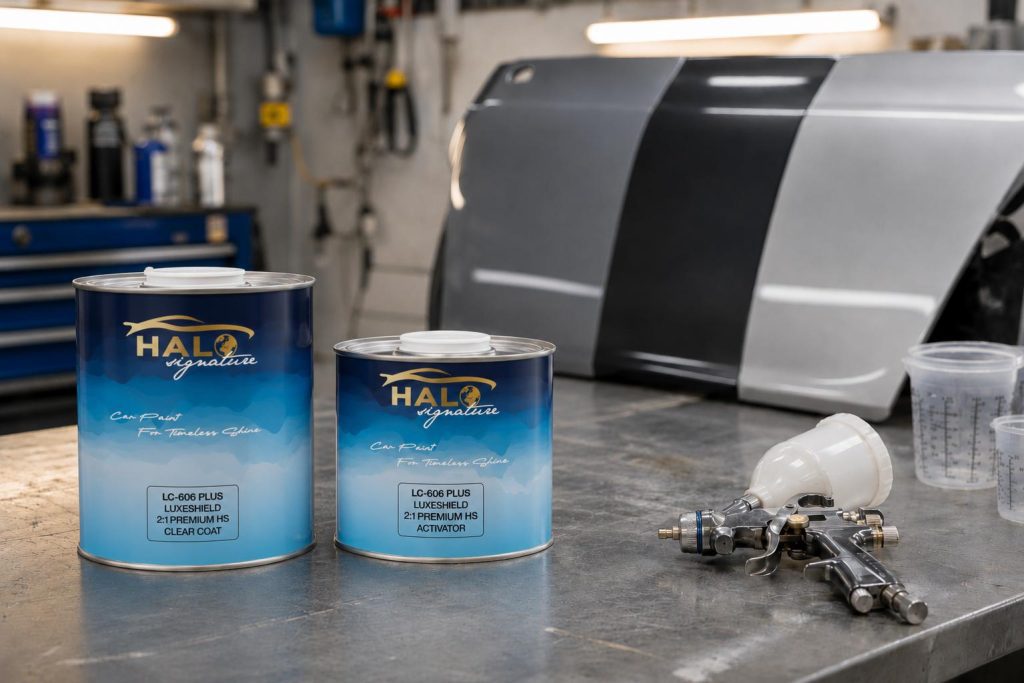
At LENC Paints, our HALO basecoat range is developed with in-house R&D specifically for tropical conditions. Colour accuracy is matched against an extensive catalogue, and the formulation is designed to work seamlessly with our 2K clear coats and primer coats, so the whole system performs as intended from the ground up.
How Basecoat Is Applied in a Professional Respray
Here’s how a proper basecoat application typically goes:
1. Surface Preparation Comes First
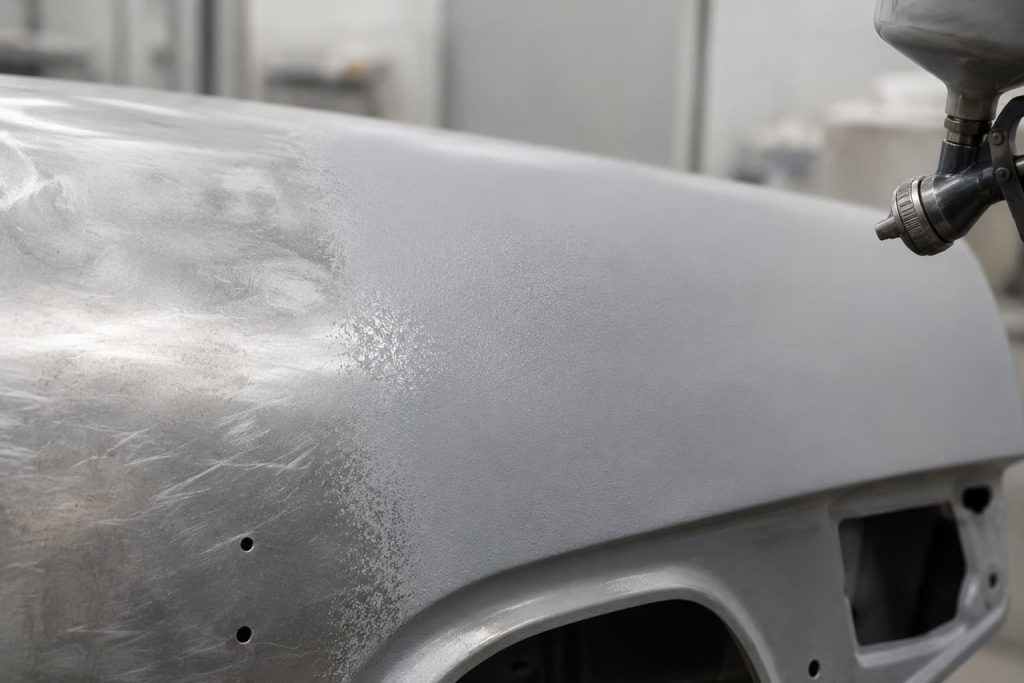
Basecoat needs a prepared surface to adhere to correctly. In a full respray, this means the panels are sanded, cleaned, and primed before the basecoat ever goes on. Any contamination or unsanded edges will show up in the finish. There are no shortcuts in prep.
2. Mixing and Reduction
Basecoat is almost always mixed with a reducer or thinner to bring it to the right viscosity for spraying. The ratio depends on the product spec sheet, the spray gun you’re using, and to some degree the ambient temperature. Using the right automotive-grade thinner makes a real difference in how the paint lays and flows off the gun.
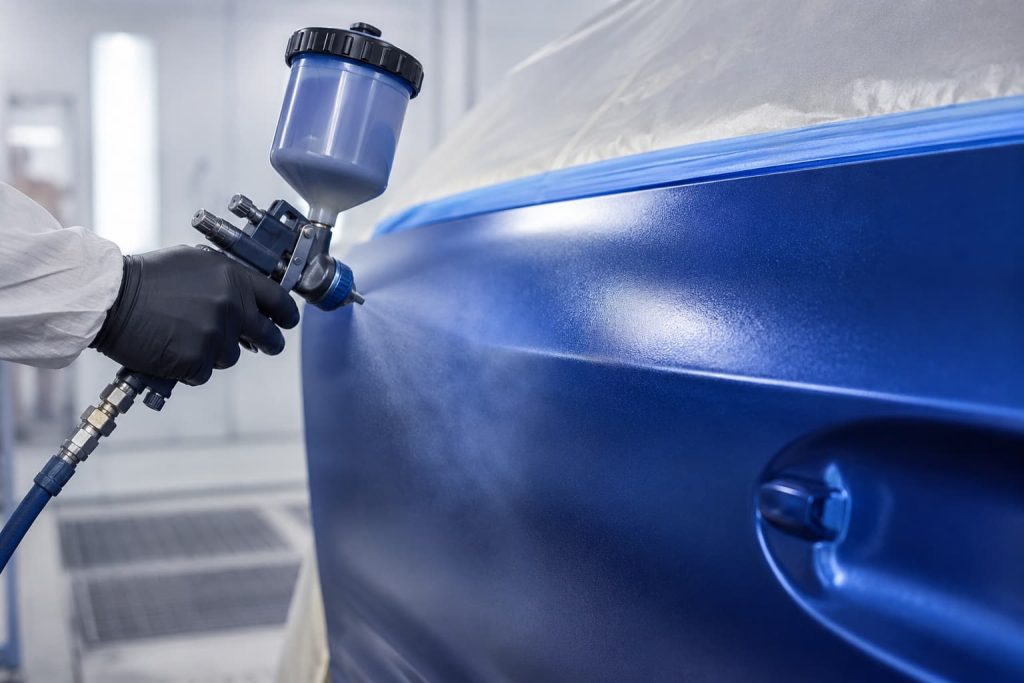
3. Spraying Technique
Basecoat is typically applied in two to three coats, with a flash-off period between each. Flash-off just means you wait for the solvent or water to evaporate before applying the next layer. Rushing this creates solvent trapping, which causes adhesion problems and can result in blistering down the line.
Keep consistent spray distance (usually around 15 to 20 cm), overlap each pass by about 50%, and maintain a steady gun speed. With metallic or pearl finishes, a final mist coat can help settle the flake orientation evenly.
4. Clear Coat Goes On After
Once the basecoat has fully flashed off and you’re happy with the colour coverage, the 2K clear coat goes on. This is what gives the finish its depth, gloss, and long-term protection. Basecoat without clear coat is incomplete, full stop.
Common Basecoat Problems and What Causes Them
Even experienced painters run into issues. Here are a few of the more common ones:
| Problem | Likely Cause |
| Poor hiding power (patchy colour) | Too few coats, wrong reduction ratio, or low-quality pigment |
| Metallic banding | Inconsistent gun speed or spray distance |
| Solvent popping | Insufficient flash-off time between coats |
| Colour mismatch on panel repairs | Incorrect colour code, poor tinting, or wrong product batch |
| Adhesion failure | Contaminated surface or incompatible primer system |
Most of these come down to either product quality or application process. Using a well-formulated basecoat from a reputable manufacturer and following the correct application procedure eliminates the majority of them.
Wrapping It Up
Basecoat is one layer in a system, and the system only works when every layer does its job. Primer gives the basecoat something to grip. Basecoat delivers the colour. Clear coat protects everything. Skip or shortcut any of these, and the whole thing underperforms.
If you’re a workshop thinking about the products you use, it’s worth evaluating not just basecoat in isolation but the full system compatibility. Products formulated to work together give you more predictable results than mixing brands across layers.
For a full walkthrough of how all of this fits together in an actual job, the article on what is a car respray gives you the complete process from panel prep to final coat.
Whether you’re sourcing basecoat for a single workshop or building out a distribution network, we’re happy to talk through your needs. Check out our range of basecoats or reach out to us today!