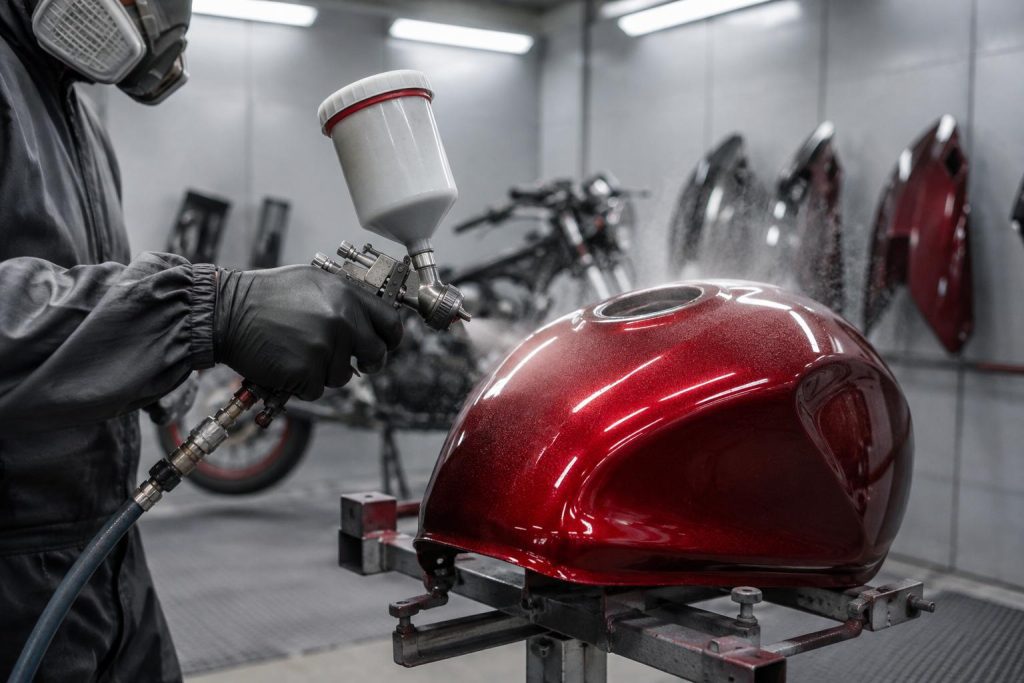
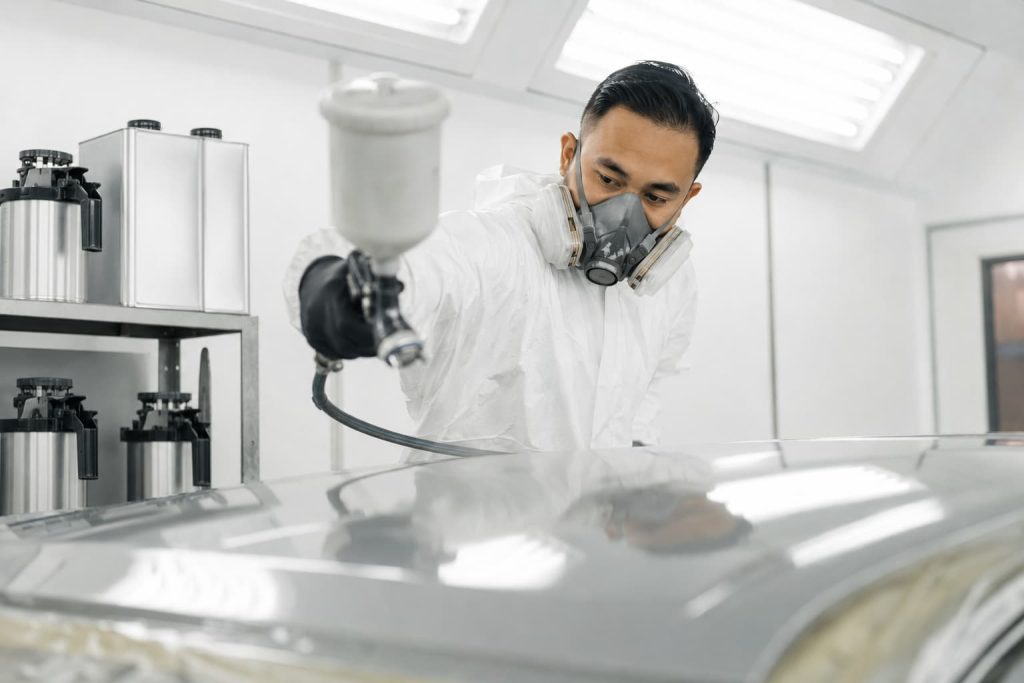
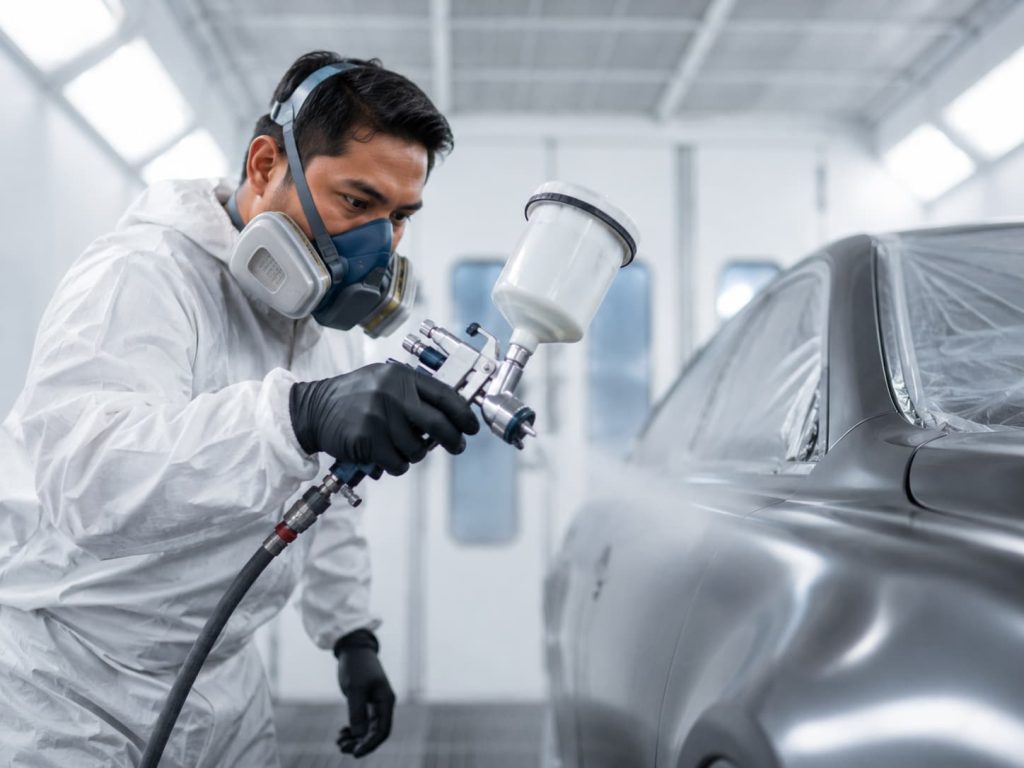
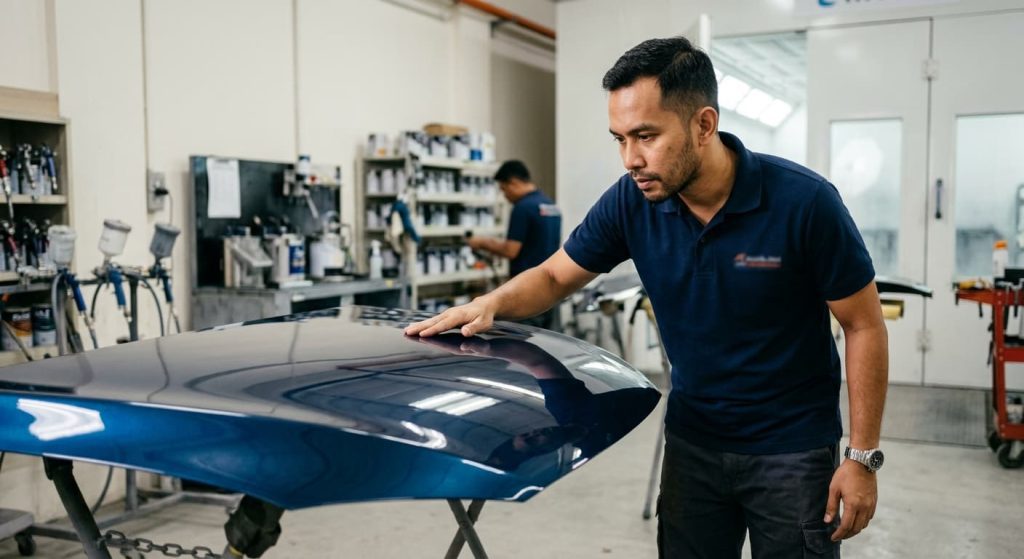
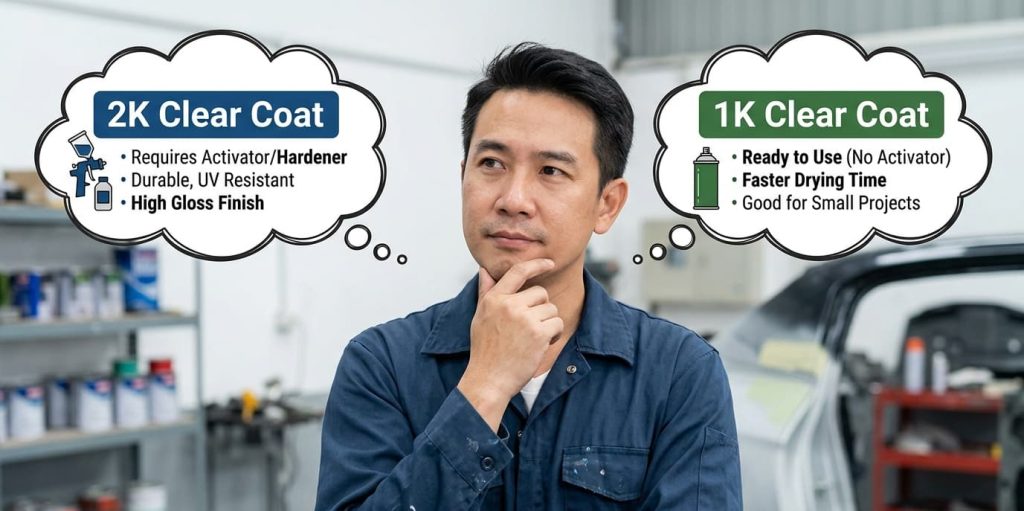
Anda baru je nak repaint motor, tapi bila tanya kedai, mereka sebut pelbagai istilah, aerosol, 2K, cat oven. Semua nampak macam cat je, tapi hasilnya jauh berbeza. Pilih jenis yang salah, dan anda mungkin dapat kerja cat yang cepat pudar atau kasar bila kena hujan panas Malaysia.
Setiap jenis cat kenderaan ini direka untuk kegunaan berbeza, dari touch-up kecil di rumah sampai respray penuh di bengkel profesional. Dalam artikel ini, kita tengok apa beza aerosol, 2K, dan cat oven, supaya anda boleh buat keputusan yang betul untuk motor anda.
Apa Itu Cat Aerosol?
Cat aerosol ialah cat dalam tin semburan yang boleh terus digunakan tanpa perlu campur apa-apa bahan. Ia yang paling senang nak dapat, boleh beli kat kedai aksesori atau hardware berdekatan, dan sesuai untuk kerja kecil-kecilan.
Ramai guna cat aerosol untuk baiki calar kecil, touch-up bahagian tangki, atau cat semula rim. Sebab tak perlu mixing atau spray gun, sesiapa pun boleh cuba sendiri di rumah.
Tapi kelemahannya pun jelas. Lapisan cat aerosol biasanya lebih nipis dan kurang tahan lasak berbanding cat profesional. Warna pun kadang tak match 100 peratus dengan warna asal motor, terutama untuk warna metalik atau pearl yang perlukan color matching yang tepat.
Bila Sesuai Guna Cat Aerosol
Cat aerosol paling sesuai untuk kerja kecil yang tak melibatkan permukaan luas. Kalau calar tu kecil je, atau anda cuma nak refresh rim dan bahagian dalam enjin, aerosol dah memadai.
Untuk respray penuh sebuah motor atau bahagian besar seperti tangki dan fairing, aerosol bukan pilihan yang praktikal. Hasil akhir biasanya tak sekemas kerja yang guna spray gun dan sistem cat berlapis.
Apa Itu Cat 2K?
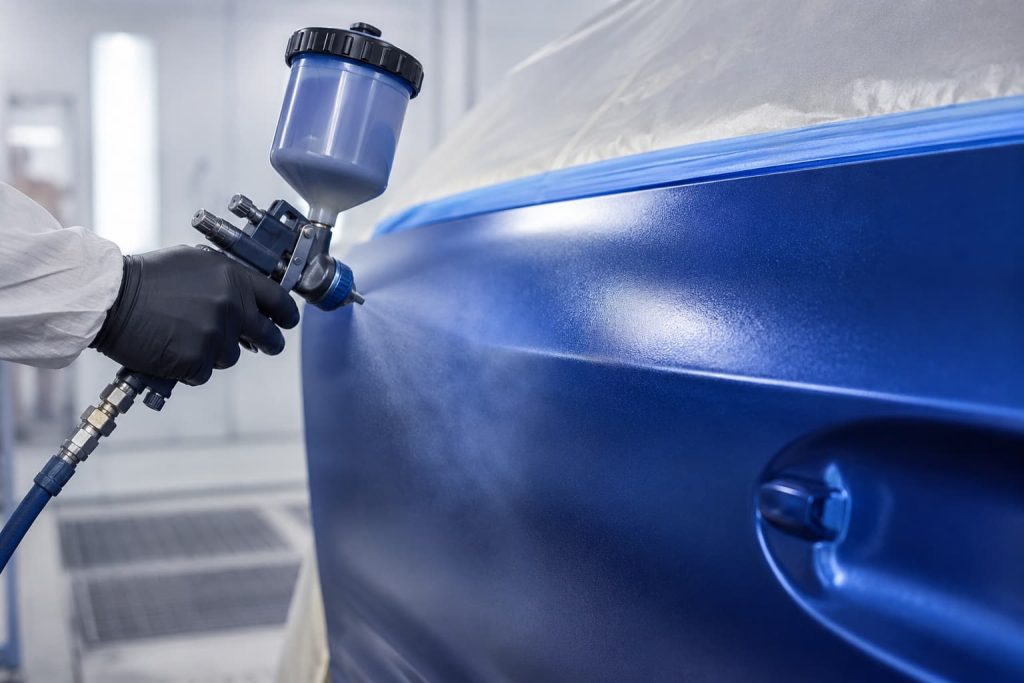
Cat 2K, atau two-component paint, merujuk kepada sistem salutan yang menggunakan dua komponen yang dicampurkan sebelum aplikasi, biasanya komponen cat atau resin bersama hardener. Selepas dicampur, kedua-duanya bertindak balas secara kimia untuk menghasilkan lapisan yang lebih keras, lebih tahan calar dan lebih tahan lama
Ini sebab kenapa 2K jadi pilihan utama di kebanyakan bengkel respray profesional di Malaysia. Prosesnya memang lebih rumit berbanding aerosol, perlukan spray gun, ruang spray booth, dan kepakaran mixing yang tepat, tapi hasil akhirnya jauh lebih kemas dan tahan lama.
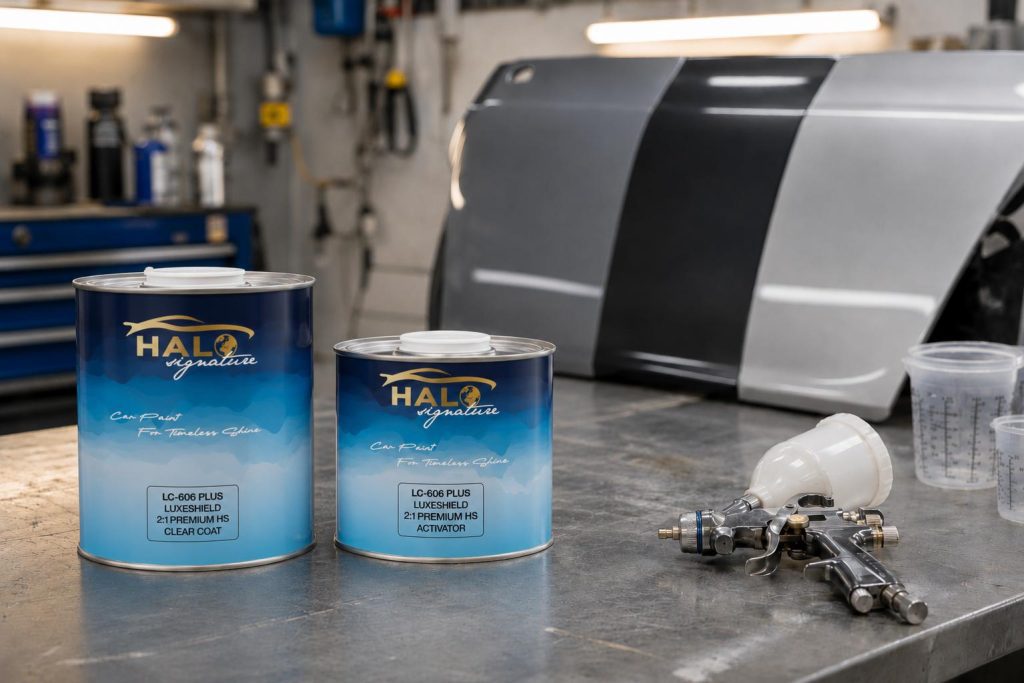
Di LENC, kami hasilkan siri HALO 2K Clear Coats yang direka khas untuk cuaca tropika Malaysia. Di LENC, kami menghasilkan siri HALO 2K Clear Coats yang direka untuk kegunaan refinishing profesional dalam cuaca tropika Malaysia. Formulasi tertentu dalam rangkaian HALO menawarkan lebih 30% peningkatan tahap kilauan, di samping aliran yang baik dan proses polishing yang lebih mudah untuk membantu bengkel mencapai kemasan berkualiti tinggi dengan lebih efisien.
Kelebihan Sistem Cat 2K
Sistem 2K profesional, khususnya 2K clear coat, boleh memberikan tahap kilauan, kekerasan dan ketahanan cuaca yang tinggi apabila digunakan mengikut sistem dan spesifikasi yang betul. Ia sesuai untuk kerja refinishing yang memerlukan kemasan berkualiti tinggi dan ketahanan jangka panjang.
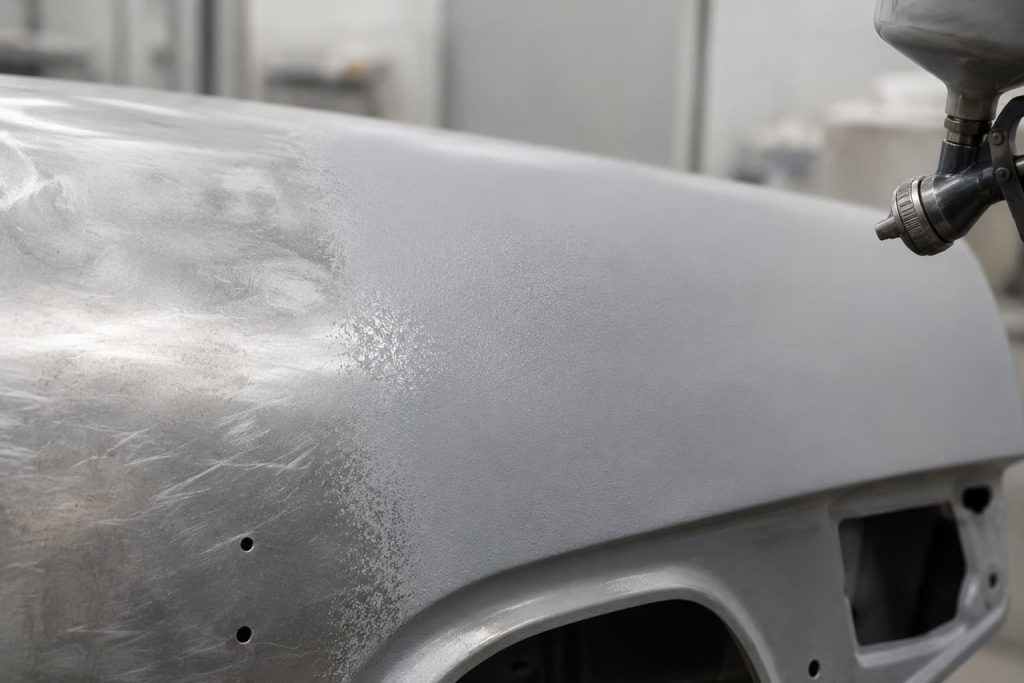
Proses ini juga perlukan primer yang sesuai sebelum lapisan basecoat dan clear coat disembur. Rangkaian HALO Primer Coats kami direka untuk pastikan permukaan logam melekat dengan baik sebelum proses pengecatan seterusnya.
Apa Itu Cat Oven?
Istilah “cat oven” biasanya merujuk kepada proses pengeringan atau curing cat menggunakan haba terkawal di dalam spray booth atau baking booth selepas proses semburan. Ia bukan satu jenis cat yang berasingan, dan sistem 2K juga boleh dikeringkan sama ada secara air dry atau dengan bantuan haba, bergantung pada formulasi produk.Kelebihan utama cat oven ialah kelajuan dan kualiti hasil akhir. Proses pengeringan yang biasanya ambil masa berjam-jam pada suhu bilik, boleh disiapkan dalam masa lebih singkat dalam oven. Lapisan cat juga jadi lebih rata dan bebas dari habuk kerana disembur dan dikeringkan dalam ruang tertutup.
Sebab tu, bengkel yang ada kemudahan spray booth dan oven biasanya caj lebih tinggi untuk servis respray. Tapi bagi ramai pemilik motor, kos tambahan ini berbaloi kerana hasil akhir yang jauh lebih tahan lama dan kemas.
Cat Oven vs Cat Kering Udara
Kelebihan utama penggunaan baking booth (Cat Oven) ialah masa pengeringan yang lebih terkawal dan lebih singkat. Suhu yang dikawal membantu mempercepat proses curing bagi produk yang memang direka untuk kaedah tersebut, sekali gus membolehkan bengkel meneruskan proses seterusnya dengan lebih cepat.
Spray booth yang bersih dan terkawal juga membantu mengurangkan risiko habuk dan pencemaran semasa proses aplikasi dan pengeringan.
Perbandingan Ringkas Jenis Cat Motor
Jenis Cat
Kegunaan Terbaik
Ciri Utama
Kos
Aerosol
Touch-up kecil, calar ringan
Mudah digunakan, sesuai untuk kerja ringan
Murah
2K
Respray, kerja profesional
Kemasan dan ketahanan tinggi bergantung pada sistem produk
Sederhana ke tinggi
Cat Oven (dengan 2K)
Kerja profesional yang perlukan curing lebih cepat
Masa curing lebih terkawal dan turnaround lebih pantas
Tinggi
Jadual ni bagi gambaran am je. Pilihan sebenar bergantung pada kegunaan, ciri utama, dan bajet anda nak lapisan cat tu kekal cantik.
Jadi, Jenis Cat Mana Yang Sesuai Untuk Anda?
Kalau calar tu kecil dan anda cuma nak baiki sendiri, cat aerosol dah cukup. Tapi untuk respray penuh atau kerja yang memerlukan kemasan lebih profesional dan tahan lama, sistem refinishing 2K yang digunakan dengan betul biasanya menjadi pilihan yang lebih sesuai. Jika bengkel mempunyai kemudahan baking booth dan produk yang digunakan menyokong proses bake curing, masa pengeringan juga boleh dipercepatkan. Yang penting, pastikan bengkel yang anda pilih guna bahan yang direka khas untuk keadaan cuaca Malaysia, bukan sekadar cat generik. Kalau anda seorang pemilik bengkel atau pengedar yang nak tahu lebih lanjut pasal produk HALO kami, jangan segan hubungi pasukan kami untuk cadangan sistem cat yang paling sesuai dengan keperluan anda.
Ask any experienced spray painter what separates a paint job that lasts from one that peels, fades, or chips within a year, and they’ll point to the same thing: surface prep and priming. The primer coat is the layer most car owners never think about because they never see it. But it’s one of the most important steps in the entire refinishing process.
This article covers what a primer coat actually is, what it does, the different types you’ll come across in a professional workshop, and why skipping it is one of the costliest shortcuts in automotive painting.
What Is a Primer Coat in Automotive Painting?
A primer coat is a preparatory coating applied directly to bare metal, body filler, or a sanded surface before the basecoat goes on. Its main job is to create a stable, clean foundation that the colour layer can grip onto properly.
Without primer, basecoat applied directly to bare metal or filler would have inconsistent adhesion, absorb unevenly, and show every imperfection underneath. The surface would also be vulnerable to rust and corrosion from moisture working its way through microscopic gaps in the topcoat.
Primer solves all of that. It seals the surface, evens out texture, promotes adhesion, and in many formulations, actively resists rust. Nobody sees it once the colour goes on, but everything above it depends on it.
Primer isn’t just a filler for scratches, though it handles that too. It does several things at once:
Adhesion promotion: Primer chemically bonds to the substrate beneath it and mechanically keys into the surface through sanding, giving the basecoat a far better grip than it would have on bare metal or plastic.
Surface levelling: Fine scratches, sanding marks, and minor surface imperfections get filled and smoothed out during the primer stage, so they don’t telegraph through to the colour coat.
Corrosion protection: Many primer formulations contain anti-corrosive pigments that actively resist rust formation, particularly important on bare metal panels or areas where old paint has been stripped back.
Sealing: Primer seals porous substrates like body filler and bare metal so the basecoat absorbs evenly. Uneven absorption leads to colour variation and patchy finishes.
Types of Primer Used in Professional Workshops
Not all primers are the same product. Different jobs call for different types, and using the wrong one affects how the rest of the paint system performs.
1. Primer Surfacer
This is the most commonly used type in bodywork and respray jobs. Primer surfacer has a higher solids content, which means it fills in sanding scratches, minor surface irregularities, and low spots. Once dry, it can be wet-sanded to a smooth, flat surface that’s ready for colour.
Primer surfacer is typically the go-to after body filler work, panel repairs, or anywhere the surface has texture that needs to be levelled before painting.
2. Etch Primer
Etch primer is designed for bare metal. It contains acid that lightly etches into the metal surface, creating a mechanical bond that regular primer surfacer can’t match. This is the first coat that goes on when you’re dealing with stripped panels or freshly fabricated metalwork.
It’s thin and doesn’t fill much, so it’s usually followed by a coat of primer surfacer before the basecoat. Think of it as the foundation under the foundation.
3. Sealer / Primer Sealer
A sealer goes on as the final step before basecoat. Its job is to lock in the layers below, prevent bleed-through from old finishes or stains, and create a uniform colour base that helps the topcoat go on evenly with fewer coats needed.
Sealers are especially useful on repairs where you’re painting over an existing finish. They stop the old paint chemistry from reacting with or contaminating the new system.
4. High-Build Primer
High-build primer contains a very high solids content, even more than standard primer surfacer. It’s used when there’s significant surface texture to fill, such as after heavy sanding, deep scratches, or rust repair work. It builds up quickly and can be blocked flat to remove deeper imperfections that a standard surfacer wouldn’t fully fill.
Primer Coat vs. No Primer: What Actually Happens
Some workshops skip primer on quick repair jobs to save time. It costs time later. Here’s what you’re risking:
What Gets Skipped
The Consequence
Adhesion layer
Paint peels or chips sooner, especially around edges and stone chips
Surface levelling
Sanding marks and texture show through the colour coat
Corrosion barrier
Moisture reaches bare metal and rust develops under the paint
Sealing
Basecoat absorbs unevenly, causing patchy or inconsistent colour
A respray done without proper priming might look acceptable in the first few weeks. Give it six months of Malaysian heat and humidity, and the problems start to show. Paint that lifts at the edges, rust spots appearing under the surface, colour that looks inconsistent in direct sunlight.
How Primer Coat Is Applied
The application process matters just as much as the product itself.
1. Surface Preparation Before Primer
The surface needs to be clean, dry, and properly sanded before primer goes on. Any grease, silicone, or contamination will cause adhesion failure regardless of how good the primer is. A wax and grease remover is standard before any primer application.
For bare metal, a light scuff with fine abrasive or a dedicated etch primer treatment ensures the best possible bond. Body filler should be fully cured and sanded to shape before priming.
2. Mixing and Application
Most professional primer coats are two-component products, mixed with a hardener before use. The mix ratio is on the product data sheet and needs to be followed precisely. Too much hardener and the primer becomes brittle. Too little and it won’t cure properly.
Our HALO primer coat range is formulated for consistent application in workshop conditions, with clear mix ratios and good build in fewer coats so your team isn’t spending extra time on the spray booth.
Spray primer in even, overlapping passes at the correct distance from the panel, typically 20 to 25 cm depending on the gun setup. Apply two to three coats with flash-off time between each, and allow full cure before sanding.
3. Sanding the Primer
Once the primer has cured, it gets wet-sanded to flatten the surface and remove any dust nibs or orange peel before the basecoat goes on. The grit used depends on the primer type and the condition of the surface, typically between 400 and 600 grit for final flatting.
This sanding step is what turns a primed panel into a surface smooth enough for colour. Don’t rush it.
Primer Compatibility with the Rest of Your Paint System
One thing that catches workshops out is using primer from one brand with topcoat products from another without checking compatibility. Paint systems are formulated to work together. The primer, basecoat, and clear coat are all designed with compatible chemistry so each layer bonds correctly to the one beneath it.
Mixing incompatible products can cause lifting, solvent attack, or adhesion failure, sometimes immediately, sometimes weeks later when the job is already back at the customer. Using the right automotive thinner for reduction also matters here, as the wrong thinner can affect how the primer flows and cures.
At LENC Paints, our primer coats are part of a complete HALO system that includes basecoats and 2K clear coats, all developed to work together. When you use the full system, you’re not guessing at compatibility. Everything is tested to perform as a unit.
When Does a Car Actually Need Re-Priming?
Not every paint job requires stripping back to bare metal and starting from scratch. But there are situations where proper re-priming is non-negotiable:
Panel replacement or new bare metal work
Collision repair where filler has been applied
Rust repair where the affected area has been ground back
Full resprays where the old finish is too far gone to paint over
Spot repairs where the existing primer has been sanded through
For lighter work, like a scuff repair on an otherwise sound panel, a sealer over the lightly prepared existing finish might be sufficient. The key is having a painter who can read the surface and make the right call.
If you want to understand how primer fits into the full job from start to finish, our article on what a car respray involves walks through the complete process step by step.
The Bottom Line on Primer
Primer isn’t exciting. Nobody orders a car respray because they want a great primer job. But it’s the layer that holds everything else together, and a good primer application is what lets the colour coat and clear coat do their jobs properly for years rather than months.
If you’re a workshop looking to upgrade the primer products you’re using, or a distributor interested in stocking a complete refinishing system, get in touch with us today. We’re happy to walk you through the right products for your workflow.
When you look at a freshly resprayed car and admire the colour, you’re looking at the basecoat. It’s the layer that carries the colour, the depth, and the visual character of the finish. Not the primer underneath it, and not the clear coat on top. The basecoat is where all the colour work happens.
If you’re a workshop owner, a technician, or just someone who wants to understand what actually goes into a professional paint job, this article breaks down what basecoat is, the different types you’ll encounter in the industry, and how it gets applied properly.
What Basecoat Actually Does in a Car Paint System
Basecoat is the colour layer in a modern automotive paint system. It sits between the primer (which prepares the surface) and the clear coat (which protects and adds gloss). On its own, basecoat has very little surface protection. It’s not designed to be tough. Its job is colour delivery, and it does that very well.
This is why you’ll almost never see a bare basecoat finish in professional work. It needs a clear coat on top to protect it from UV rays, abrasion, humidity, and everything else Malaysian weather throws at a vehicle. The two work as a system, and skipping either one compromises the whole job.
Not all basecoats are the same. The type you choose affects colour accuracy, application behaviour, drying time, and overall finish quality. Here are the main types used in professional automotive refinishing:
1. Solvent-Based Basecoat
Solvent-based (also called conventional) basecoats have been the industry standard for decades, and they’re still widely used across Malaysian workshops. They deliver excellent colour depth and opacity, they’re forgiving to spray, and they dry relatively fast.
The main trade-off is VOC (volatile organic compound) content. Solvent-based products release more emissions during application, which is why spray booth ventilation matters. Despite tightening environmental standards in some markets, solvent-based basecoats remain the practical choice for most professional bodyshops in this region due to performance and cost.
2. Water-Based Basecoat
Water-based basecoats use water as the primary carrier instead of solvents. They’re cleaner environmentally and produce lower VOC emissions. Many car manufacturers now specify water-based paints for their OEM production lines.
For refinishing work, water-based products require a bit more care. They’re sensitive to humidity and temperature during application, and they typically need an infrared dryer or a well-ventilated booth to flash off properly. In tropical conditions like Malaysia’s, these environmental factors matter more than they would in a temperate climate.
We’ve covered the differences between solvent-based and water-based car paint in a separate article if you want a deeper comparison before deciding which direction suits your workshop.
3. Metallic and Pearl Basecoat
These aren’t separate categories by chemistry, but they’re worth distinguishing by visual effect. Metallic basecoats contain aluminium flake particles that reflect light and give the finish its characteristic shimmer. Pearl basecoats use mica or ceramic flakes that create a colour shift depending on the viewing angle.
Spraying these correctly takes more skill. Flake orientation is affected by spray distance, gun pressure, and the number of coats applied. Get it wrong and you’ll see banding, shadowing, or inconsistent flake alignment. Proper technique and consistent passes are everything with metallic and pearl finishes.
4. Solid Colour Basecoat
Solid colours, think white, black, red, or any plain single-tone, don’t contain metallic or pearl flakes. They’re generally easier to apply than effect finishes and are more forgiving of minor technique variations. That said, colour accuracy still matters enormously, especially on partial panel repairs where the new coat needs to match the surrounding paintwork.
What Goes Into a Good Basecoat Product?
The quality of a basecoat comes down to a few things: pigment quality, binder resin, and how the product is formulated for the conditions it’ll be used in. A well-formulated basecoat gives you:
Consistent colour accuracy batch to batch
Good hiding power, meaning fewer coats to reach full opacity
Compatibility with the primers and clear coats in your system
Stable performance in high humidity and heat conditions
At LENC Paints, our HALO basecoat range is developed with in-house R&D specifically for tropical conditions. Colour accuracy is matched against an extensive catalogue, and the formulation is designed to work seamlessly with our 2K clear coats and primer coats, so the whole system performs as intended from the ground up.
How Basecoat Is Applied in a Professional Respray
Here’s how a proper basecoat application typically goes:
1. Surface Preparation Comes First
Basecoat needs a prepared surface to adhere to correctly. In a full respray, this means the panels are sanded, cleaned, and primed before the basecoat ever goes on. Any contamination or unsanded edges will show up in the finish. There are no shortcuts in prep.
2. Mixing and Reduction
Basecoat is almost always mixed with a reducer or thinner to bring it to the right viscosity for spraying. The ratio depends on the product spec sheet, the spray gun you’re using, and to some degree the ambient temperature. Using the right automotive-grade thinner makes a real difference in how the paint lays and flows off the gun.
3. Spraying Technique
Basecoat is typically applied in two to three coats, with a flash-off period between each. Flash-off just means you wait for the solvent or water to evaporate before applying the next layer. Rushing this creates solvent trapping, which causes adhesion problems and can result in blistering down the line.
Keep consistent spray distance (usually around 15 to 20 cm), overlap each pass by about 50%, and maintain a steady gun speed. With metallic or pearl finishes, a final mist coat can help settle the flake orientation evenly.
4. Clear Coat Goes On After
Once the basecoat has fully flashed off and you’re happy with the colour coverage, the 2K clear coat goes on. This is what gives the finish its depth, gloss, and long-term protection. Basecoat without clear coat is incomplete, full stop.
Common Basecoat Problems and What Causes Them
Even experienced painters run into issues. Here are a few of the more common ones:
Problem
Likely Cause
Poor hiding power (patchy colour)
Too few coats, wrong reduction ratio, or low-quality pigment
Metallic banding
Inconsistent gun speed or spray distance
Solvent popping
Insufficient flash-off time between coats
Colour mismatch on panel repairs
Incorrect colour code, poor tinting, or wrong product batch
Adhesion failure
Contaminated surface or incompatible primer system
Most of these come down to either product quality or application process. Using a well-formulated basecoat from a reputable manufacturer and following the correct application procedure eliminates the majority of them.
Wrapping It Up
Basecoat is one layer in a system, and the system only works when every layer does its job. Primer gives the basecoat something to grip. Basecoat delivers the colour. Clear coat protects everything. Skip or shortcut any of these, and the whole thing underperforms.
If you’re a workshop thinking about the products you use, it’s worth evaluating not just basecoat in isolation but the full system compatibility. Products formulated to work together give you more predictable results than mixing brands across layers.
For a full walkthrough of how all of this fits together in an actual job, the article on what is a car respray gives you the complete process from panel prep to final coat.
Whether you’re sourcing basecoat for a single workshop or building out a distribution network, we’re happy to talk through your needs. Check out our range of basecoats or reach out to us today!
Running a workshop in Malaysia means dealing with conditions that most global product specs weren’t designed for. The heat doesn’t let up, humidity sits high year-round, and customers expect a mirror-level finish every single time. Choosing the wrong clear coat doesn’t just affect quality. It hits your turnaround time, your rework rate, and eventually, your reputation.
The problem is there’s no shortage of options on the market. Walk into any automotive supply shop and you’ll find products at wildly different price points, all claiming brilliant gloss and long-lasting durability. So how do you cut through all that and actually pick the right one for your workshop?
Here are five things that genuinely matter.
1. UV and Weather Resistance Built for the Malaysian Climate
Malaysia’s climate is relentless. Intense UV exposure, daily heat cycles, and humidity that rarely drops below 70% will degrade a clear coat that wasn’t engineered for it. Yellowing, hazing, and early peeling are the most common failure points for products formulated to general automotive specs rather than tropical conditions.
When evaluating a product, look beyond the brochure claims and check whether the formulation was actually designed for Southeast Asian use. A clear coat that performs well in a European market doesn’t automatically hold up on a Malaysian parking lot at 2pm in July. Moisture-resistant curing and strong UV inhibitors are what you want. Your customers’ resprays need to hold that finish for years, not start fading before their next service.
2. Drying and Processing Time
In a busy workshop, time is one of the tightest resources you manage. A clear coat that takes too long to flash between coats, or too long to cure before buffing, directly affects how many jobs you can complete in a day.
Flash Time vs. Full Cure Time
These are two different measurements and it’s worth understanding both before committing to a product. Flash time is the waiting period between coats. Full cure time is how long before the panel can be safely polished, buffed, or handed back to the customer. A product might advertise a short flash time but have a long cure window, which can be a real problem if your workflow involves same-day delivery on respray jobs.
How Processing Speed Affects Your Workshop Throughput
Cutting your spray processing time by even 20 to 30 percent adds up significantly across a full month of work. Our HALO 2K Clear Coat is formulated to reduce spray processing time by approximately 30% compared to standard products. That’s a meaningful difference when you’re running multiple bays and back-to-back bookings.
3. Gloss Level and Finish Quality
A quality clear coat needs to do two things well: protect the underlying paint and make it look like glass. If your clear is dulling the basecoat beneath it, or leaving noticeable texture after buffing, that’s a problem regardless of what the label says.
Before committing to any new product, spray a test panel first. Evaluate the gloss under different lighting conditions: direct sunlight, your booth lighting, and natural shade. Look for orange peel, cloudiness, or uneven sheen right after application. Issues at this stage are a reliable predictor of problems at scale.
Good levelling properties matter too. A quality clear coat flows out smoothly after application and self-levels before it starts to tack. This means less polishing time after cure and less mechanical abrasion on the paint system overall, which is better for the finish and better for your team’s time.
4. Compatibility With Your Existing Paint System
Clear coats don’t perform in isolation. They’re part of a layered system: primer, basecoat, clear. If any of those layers aren’t compatible with each other, you risk adhesion failure, solvent pop, or lifting. These problems don’t always show up immediately but they create costly rework later, often after the car has already left your shop.
This is why running a unified paint system from a single supplier makes sense for most workshops. When your primer coats, basecoats, and 2K clear coat are all engineered to work together, you take the compatibility guesswork out of the equation. Mixing brands across layers introduces variables that can be genuinely difficult to diagnose when something goes wrong months down the line.
If you’re currently running a mixed-supplier setup, do controlled test panels before committing to any new product combination, especially across primer and clear.
5. Real Cost Efficiency, Not Just Price Per Litre
Cheap clear coats exist. Some of them are usable. But if a low-cost product is quietly increasing your rework rate, the savings don’t add up. What you’re actually looking for is cost efficiency across the full job: coverage rate, how far a litre gets you, rework frequency, and how well the finish holds before customers come back with complaints.
Two-component (2K) clear coats do cost more upfront than 1K options, but the durability difference is real. If you haven’t compared both properly, our article on 2K vs 1K clear coat breaks down exactly what you’re trading off between the two.
Batch-to-batch consistency is another factor worth thinking about. A product manufactured under ISO 9001:2015 certification with in-house R&D means you’re not guessing whether this month’s drum will perform the same as last month’s. Consistency matters when you’re building a reputation on your finish quality.
How To Properly Trial a New Clear Coat Before You Commit
Don’t test a new clear coat on a customer’s car. Use this process instead:
Get a scrap panel or test bonnet
Apply your standard primer and basecoat underneath
Spray the clear at the manufacturer’s recommended mix ratio and flash intervals
Buff and inspect after 24 hours: gloss level, surface texture, cure hardness
Leave the panel outdoors for a week and check for early signs of UV or moisture response
A product that passes this gives you a far more reliable basis for making the switch than spec sheets alone.
Choosing the Right Automotive Clear Coat for Your Workshop
The best clear coat for a Malaysian workshop checks all five boxes: tropical climate durability, processing speed, finish quality, system compatibility, and genuine cost efficiency. No single spec number tells the whole story, and a product that scores well on one but poorly on the rest will show its weaknesses over time.
If you’re looking for a 2K clear coat built specifically for local conditions, our HALO 2K Clear Coat is formulated for exactly that. Designed in Malaysia, backed by ISO certification, and part of a complete paint system that runs from primer through to topcoat.
New to 2K products and want to understand how they work before making a decision? Our guide on understanding 2K clear coat is a good starting point.
Kalau anda pernah tengok proses kerja di bengkel cat kereta, mungkin anda perasan teknisi tu bukan sekadar ambil satu tin cat dan terus sembur. Ada proses, ada lapisan, dan ada jenis cat yang berbeza untuk setiap peringkat kerja.
Inilah yang membezakan bengkel profesional dengan kerja “cucuk” yang tidak tahan lama. Pro guna sistem cat yang betul. Dan sistem tu melibatkan sekurang-kurangnya tiga jenis cat utama yang masing-masing ada fungsi tersendiri.
Kalau anda nak faham kenapa cat bengkel mahal sedikit berbanding cat biasa, atau sekadar ingin tahu apa yang sebenarnya digunakan dalam proses semburan penuh, artikel ini adalah untuk anda.
1. Cat Primer: Asas yang Tentukan Segalanya
Sebelum sebarang warna disembur, permukaan kereta perlu disediakan dengan betul. Di sinilah cat primer memainkan peranan penting, dan ia sering jadi lapisan yang paling dipandang ringan oleh bengkel yang kurang berpengalaman.
Apa Fungsi Cat Primer?
Cat primer bukan sekadar “lapisan pertama”. Ia ada beberapa fungsi utama:
Memastikan cat warna melekat dengan kuat pada permukaan logam atau filler badan
Mengisi permukaan yang tidak rata, calar halus, atau kesan tampalan
Melindungi permukaan logam daripada karat sebelum dicat semula
Memberi asas warna yang seragam supaya warna lapisan atas kelihatan betul dan konsisten
Tanpa primer yang baik, cat warna yang anda sembur selepas tu mungkin tidak melekat dengan sempurna. Atau hasilnya tidak sekata walaupun warna dipilih tepat. Dalam jangka masa panjang, ini boleh menyebabkan cat terangkat, gelembung, atau habis dalam masa yang lebih cepat daripada sepatutnya.
Jenis Primer yang Biasa Digunakan Bengkel Pro
Tidak semua primer sama. Bergantung pada jenis kerja dan keadaan panel, bengkel profesional akan pilih primer yang berbeza:
Epoxy primer untuk perlindungan karat yang lebih baik, terutama pada panel yang telah diketuk atau ada karat awal
Polyester primer surfacer untuk mengisi permukaan yang dalam atau tidak rata selepas tampalan badan
2K primer untuk kerja yang memerlukan adhesion dan filling dalam masa yang sama
Untuk bengkel yang nak keputusan konsisten dan meminimumkan kerja baiki semula, primer coat berkualiti adalah pelaburan yang berbaloi. Jimat pada primer sering bermaksud bayar dua kali pada kerja semula.
2. Basecoat: Lapisan Warna yang Memberi Identiti Kereta
Selepas primer kering dan di-sand dengan betul, barulah cat warna atau basecoat disembur. Ini lapisan yang kelihatan dari luar dan yang memberi kereta tu warnanya. Ia juga lapisan yang paling mudah nampak kalau tidak disembur dengan betul.
Apa Itu Basecoat dan Kenapa Ia Tidak Glossy?
Ini soalan biasa yang sering tanya. Basecoat adalah lapisan warna utama dalam sistem cat dua atau tiga peringkat. Ia tidak mengandungi lacquer atau pelindung, jadi ia tidak glossy dengan sendirinya selepas disembur. Permukaan akan kelihatan matte atau doff selepas basecoat kering.
Kilat tu datang dari clear coat yang disembur di atas. Sebab itulah basecoat perlu disembur dengan sempurna dari segi coverage dan keseragaman warna. Lepas clear coat diaplikasi, semua ketidakseragaman akan kelihatan dengan lebih ketara di bawah cahaya.
Kenapa Color Matching Adalah Kemahiran Tersendiri
Ini satu cabaran besar dalam kerja cat kereta, terutama untuk kerja baiki separa atau satu panel sahaja. Warna kereta yang sama boleh kelihatan berbeza bergantung pada umur cat asal, jenama cat yang digunakan sebelum ni, dan cara cahaya memantul pada sudut yang berbeza.
Bengkel yang serius akan guna sistem basecoat yang ada katalog warna yang luas dan sistem pencocokan warna yang tepat. Ini bukan sekadar pilih warna yang “lebih kurang sama” tapi cari padanan yang betul-betul tepat supaya panel yang dicat tidak kelihatan berbeza daripada panel sebelahnya.
Nak tahu lebih lanjut tentang jenis-jenis cat yang ada di pasaran? Artikel kami tentang jenis cat automotif boleh jadi rujukan berguna.
3. Clear Coat: Pelindung Terakhir yang Tentukan Hasil Akhir
Ini lapisan ketiga dan yang paling kritikal dari segi penampilan akhir dan daya tahan jangka panjang. Clear coat adalah cat telus yang disembur di atas basecoat untuk memberi kilat, perlindungi warna daripada UV, dan tingkatkan ketahanan permukaan kereta.
Kenapa Clear Coat Penting untuk Iklim Malaysia
Malaysia ada iklim yang agak keras untuk cat kereta. UV yang kuat sepanjang tahun, kelembapan tinggi, dan panas yang tidak banyak berubah boleh menjejaskan clear coat yang tidak diformulasi untuk cuaca tropika. Clear coat yang tidak sesuai atau berkualiti rendah boleh menjadi kekuningan, kabur, atau mula pecah dalam masa dua hingga tiga tahun sahaja.
Sebab itulah pemilihan clear coat bukan sekadar soal harga per liter, tapi soal berapa lama kerja anda tahan. Pelanggan yang keretanya menanggalkan clear coat dalam masa dua tahun adalah pelanggan yang tidak akan balik ke bengkel anda.
Perbezaan 1K dan 2K Clear Coat
Satu perkara yang wajib difahami setiap teknisi bengkel adalah perbezaan antara 1K dan 2K clear coat.
1K Clear Coat
2K Clear Coat
Komponen
Satu komponen, sedia sembur
Dua komponen, perlu dicampur dengan hardener
Ketahanan
Lebih rendah
Lebih tinggi
Kilat akhir
Sederhana
Sangat baik
Masa proses
Lebih cepat tapi hasil lemah
Lebih terkawal dan konsisten
Kegunaan biasa
Touch-up kecil
Semburan penuh profesional
Untuk kerja bengkel yang serius, 2K clear coat adalah pilihan standard. Ketahanannya lebih baik, dan hasilnya lebih konsisten dari satu job ke job yang lain. Kalau anda belum familiar dengan perbezaan keduanya, artikel kami tentang 2K vs 1K clear coat boleh bantu jelaskan lebih lanjut.
Kenapa Ketiga-Tiga Jenis Cat Ini Perlu Digunakan Bersama
Soalan yang sering tanya: “Boleh tak terus guna cat warna tanpa primer?” atau “Boleh tak skip clear coat untuk jimat masa?”
Boleh. Tapi risikonya tinggi.
Setiap lapisan dalam sistem cat ada fungsi yang tidak boleh digantikan oleh lapisan lain. Primer pastikan adhesion. Basecoat bagi warna. Clear coat bagi perlindungan dan kilat. Kalau salah satu dilangkau, sistem tu tidak berfungsi sepenuhnya, dan hasilnya akan kelihatan dalam tempoh masa yang lebih cepat daripada yang pelanggan jangkakan.
Yang sama pentingnya, ketiga-tiga produk ini perlu serasi antara satu sama lain. Itulah sebabnya bengkel pro biasanya guna sistem cat dari satu pembekal, bukan campuran pelbagai jenama untuk setiap lapisan. Bila primer, basecoat, dan clear coat diformulasi untuk bekerja bersama, risiko masalah seperti adhesion failure, solvent pop, atau cat terangkat berkurangan dengan ketara.
Artikel kami tentang cat kereta Malaysia juga ada perbincangan lanjut pasal kenapa pemilihan cat yang betul penting dalam konteks pasaran tempatan.
Sistem Cat Pro untuk Bengkel Malaysia
Sistem cat HALO kami direka khas untuk industri automotive refinishing di Malaysia. Dari primer hingga basecoat hingga 2K clear coat, setiap produk diformulasi untuk bekerja bersama dan tahan dalam iklim tropika. Lebih dari 500 bengkel di Malaysia sudah guna produk HALO dan AURORA kami dalam kerja harian mereka.
Kalau anda sedang pertimbangkan untuk tukar ke sistem cat yang lebih konsisten dan boleh dipercayai, atau nak tahu lebih lanjut tentang perbezaan antara cat berasaskan pelarut dan cat berasaskan air, kami ada sumber yang boleh bantu anda buat keputusan yang lebih yakin.
The question of solvent-based vs water-based automotive paint comes up constantly in refinishing circles. Both systems have been around long enough to earn real credibility, and both have genuine shortcomings. The debate isn’t about which one is better in an absolute sense. It’s about which one fits your shop, your workflow, and the conditions you’re working in.
Understanding what actually separates the two systems helps you make a practical decision rather than just following what’s popular or what the rep recommended last month.
What Is Solvent-Based Automotive Paint?
Solvent-based paint, also called conventional or cellulose-based paint, uses organic solvents to carry the pigment and binder in a sprayable liquid form. When the paint hits the panel, the solvents evaporate during curing, and what’s left is the dried paint film bonded to the surface.
This system has been the industry standard for most of automotive refinishing’s history. In markets across Southeast Asia, it remains widely used for everyday repair work, and there are legitimate reasons for that staying power.
Pros of Solvent-Based Paint
Application is forgiving. Painters who’ve worked with conventional systems for years know how the product behaves, and that familiarity translates directly into efficiency on the shop floor. The paint responds predictably to standard spray equipment, dry times are generally fast in normal conditions, and it doesn’t demand significant technique adjustments from technicians already trained on conventional systems.
Adhesion on existing paint layers and aged surfaces is another advantage. The solvents in the formulation help the paint bite into the substrate, which is particularly useful for panel repair work where you’re painting over previous coatings rather than starting from bare metal.
Colour matching for solid and standard metallic finishes is reliable and well-supported by established colour catalogues. For workshops handling high volumes of standard repair jobs daily, the system delivers consistent results without adding complexity to the process.
Cons of Solvent-Based Paint
VOC content is the main issue. Volatile organic compounds are released into the air during application and drying at significant levels. In a workshop setting, this means respiratory protection, proper ventilation, and extraction systems aren’t optional. They’re non-negotiable from both a health and regulatory compliance standpoint.
The regulatory trend is also moving against high-VOC systems globally. Markets in Europe have largely legislated most conventional solvent-based paints out of standard use, and this pressure is gradually reaching other regions. If your business is growing internationally or you’re operating in a market where environmental standards are tightening, this is a factor worth building into your long-term planning.
What Is Water-Based Automotive Paint?
Water-based, or waterborne, automotive paint uses water as the primary carrier instead of organic solvents. The formulation still contains some solvents, but at much lower concentrations. Adoption has accelerated globally, driven by environmental regulations, OEM requirements, and genuine performance advantages in specific applications. In many markets, it’s no longer an emerging alternative. It’s already the standard.
Pros of Water-Based Paint
Colour accuracy is where waterborne systems genuinely outperform solvent-based alternatives, particularly on metallic and pearl finishes. The way metallic flake particles orient in waterborne paint during flash-off produces a depth and visual consistency that’s hard to replicate with conventional systems. For workshops doing premium repair work or matching complex OEM colour effects on newer vehicles, this is a meaningful difference in the final result.
VOC emissions are significantly lower, which creates a safer working environment and better positions workshops against tightening environmental regulations. For businesses pursuing ISO certification or working with clients that have compliance requirements, this matters on a practical level.
Waterborne paint is also aligned with global OEM standards. Most major vehicle manufacturers now use waterborne systems in their factory processes. Working with a compatible system makes it easier to match and integrate your refinishing work with original factory finishes, which directly affects how well the repaired area blends.
Cons of Water-Based Paint in Tropical Climates
This is where things get specific to our context in Malaysia. Water-based paint is sensitive to humidity and temperature during application and flash-off, and in a tropical climate where ambient humidity regularly sits above 80%, those conditions matter a lot. Without adequate air movement, booth temperature control, and proper spray technique, waterborne paint won’t flash correctly. The result is longer cycle times and inconsistent quality.
Slower flash times compared to solvent-based systems can affect workshop throughput, especially in high-volume repair environments where booth turnaround speed directly impacts revenue. Moving to waterborne also means retraining for painters used to conventional systems, since the application technique and timing are different.
The infrastructure investment is real. Spray booths need proper airflow, heating, and humidity management to support waterborne paint reliably. For workshops not already set up for this, it’s a genuine upfront cost to factor in.
Key Comparison of Solvent-Based Paint vs Water-Based Paint
Criteria
Solvent-Based (Conventional)
Water-Based (Waterborne)
Application ease
Familiar and predictable with standard spray equipment. Fast dry times. Forgiving for trained painters.
Requires retraining. Technique and timing differ from conventional systems.
VOC emissions
High VOC release. Respiratory protection, ventilation, and extraction systems are mandatory.
Significantly lower VOC. Safer working environment; supports compliance and ISO certification.
Colour accuracy
Reliable for solid and standard metallic finishes. Well-supported by established colour catalogues.
Superior depth and consistency on metallic and pearl finishes due to better flake orientation during flash-off.
Adhesion
Strong. Solvents help paint bite into substrates, especially useful over existing coatings.
Generally good, though less aggressive on aged or previously coated surfaces.
Regulatory outlook
Largely phased out in Europe. Regulatory pressure increasing globally.
Aligned with tightening global regulations. Already the standard in many markets.
OEM compatibility
Diverging from modern factory finishes as OEMs shift to waterborne systems.
Compatible with most major OEM factory processes. Improves blend quality on newer vehicles.
Climate sensitivity
Performs reliably in tropical humidity and variable conditions.
Sensitive to humidity above 80%. Requires adequate airflow and temperature control to flash correctly.
Workshop throughput
Faster dry and flash times support higher booth turnaround.
Slower flash times can reduce throughput in high-volume repair environments.
Infrastructure cost
Compatible with standard spray booths. Low upfront investment.
Requires booth airflow, heating, and humidity management. Significant upfront cost for unprepared workshops.
How to Choose the Right Automotive Paint System for Your Workshop
The honest answer: it depends on what you’re doing and how your shop is currently set up.
High-volume workshops handling standard collision repairs in conventional spray setups will likely find solvent-based paint more practical for day-to-day throughput. The system is well-understood, reliable, and doesn’t require significant changes to workflow or infrastructure.
Workshops focused on premium repairs, colour-critical finishes, or newer vehicles are in a stronger position to benefit from waterborne systems. The colour accuracy advantage for complex finishes is real, and if your booth is already climate-controlled, most of the operational challenges become manageable.
Many professional workshops run both systems in parallel, using waterborne basecoats where colour precision matters and solvent-based systems for primers and general refinishing. There’s no rule requiring a full commitment to one system over the other.
What matters most is choosing a paint formulated for the actual conditions you’re applying it in. At LENC Paints, our HALO basecoat range is developed specifically for Southeast Asian conditions. Tropical climate performance, UV resistance, and high-humidity application stability are built into the formulation from the ground up.
The same applies to our HALO 2K Clear Coat, which works with both solvent and waterborne basecoats and is built for long-term durability in tropical conditions.
Solvent-based and water-based automotive paint both have a legitimate place in professional refinishing. Neither is universally superior. The right choice comes down to your shop’s infrastructure, your team’s existing skill set, and the type of work you take on most.
Get the match right between your paint system and your operating conditions, and you’ll see consistent, reliable results. Get it wrong, and no formulation will compensate for the mismatch.
A car respray gets talked about a lot, but the actual process behind it is rarely explained clearly. If you’re a workshop owner quoting a job, a technician trying to set client expectations, or a car owner trying to understand what you’re paying for, knowing what goes into a proper respray matters. It helps you understand the cost, the timeline, and what separates a quality result from one that won’t last.
Here’s a complete walkthrough of what a car respray actually involves.
What is a Car Respray?
A car respray is the process of repainting a vehicle’s exterior, either in part or in full. It involves preparing the surface, applying primer, laying down the colour coat, and sealing everything with a protective clear coat. The result is a fresh, uniform paint finish that either restores the vehicle’s appearance or replaces it entirely.
The word “respray” gets used loosely, but there’s a real difference between a proper multi-stage refinishing job and a quick colour touch-up. A genuine respray covers the full coating system, and preparation work typically takes longer than the spraying itself.
When Do You Need a Car Respray?
Collision damage is the most common reason. After an accident, repaired or replaced panels need to be repainted to match the rest of the vehicle. Depending on the extent of the damage, this could mean respraying a few panels or the entire car.
Paint deterioration is the other major trigger. In Malaysia’s tropical climate, UV exposure, heat, and humidity accelerate paint breakdown. Clear coat oxidation, peeling, and fading are all signs that the coating system has reached the end of its service life. A full respray can bring a structurally sound vehicle back to a clean, solid appearance.
Some owners request resprays for purely cosmetic reasons, either to change the colour or to refresh a vehicle that’s been well-maintained mechanically but has taken visible exterior wear over the years. Fleet operators use resprays regularly to maintain consistent brand presentation across their vehicles.
The Car Respray Process, Step by Step
Understanding the steps involved gives you a realistic picture of why a quality respray takes the time it does.
Step 1: Assessment and Bodywork
Before any automotive paint goes near the vehicle, the condition of the bodywork gets assessed. Dents, scratches, rust spots, and collision damage all need to be addressed before the refinishing process begins. Panels with structural or surface damage go through repair work at this stage.
Skipping or rushing this step is the most common reason resprays fail. Paint applied over unaddressed bodywork damage will never look right, and the problems will show through the final finish.
Step 2: Washing, Masking, and Surface Prep
The vehicle is thoroughly washed to remove all dirt, grease, and surface contaminants. Any panel, trim piece, rubber seal, or glass that isn’t being painted gets masked off to protect it from overspray.
Once cleaned and masked, the painted surfaces are sanded to create a surface profile that primer can grip onto. If the existing paint is in poor condition, it may be stripped further back or taken down to bare metal in the affected areas.
Step 3: Priming
Primer goes on before any colour coat. Its job is to seal the surface, prevent rust where bare metal is exposed, improve adhesion for the basecoat, and create a uniform foundation that supports consistent colour across the panel.
Different situations call for different primer types. Epoxy primers seal bare metal and offer corrosion resistance. High-build primers help level out surface texture where minor imperfections remain after sanding. Choosing the right primer for each surface condition directly affects how the colour coat performs over it.
After priming, the surface is sanded again at a finer grit to ensure a smooth, even base before the colour goes on.
Step 4: Applying the Basecoat
The basecoat is the colour layer. This is where the car gets its final colour, and it’s where precise colour matching matters most.
For partial resprays, the new colour needs to match the surrounding panels accurately. That matching process starts before the paint hits the panel, with careful colour formulation and calibration. Multiple coats of basecoat go on, with flash-off time between each layer to allow solvents to clear before the next coat is applied.
At LENC Paints, our HALO basecoat range covers an extensive colour catalogue across all major colour families and is formulated for consistent colour accuracy under tropical conditions. Reliable basecoat performance at this stage is what makes the finished result look right. Explore our full car colour range here!
Step 5: Applying the Clear Coat
Clear coat is the protective layer that goes over the basecoat. It provides gloss, depth, and the physical protection that shields the colour from UV, moisture, minor abrasions, and general wear. Without a quality clear coat, the basecoat would degrade quickly, and the paint would lose its depth and shine within a short time.
Professional-grade 2K polyurethane clear coats are the standard for automotive refinishing. Our HALO 2K Clear Coat is formulated to deliver approximately 30% enhanced gloss, along with easier application and polishing compared to standard products. This helps workshops achieve a high-quality finish more efficiently and consistently.
Like the basecoat, clear coat is applied in multiple coats with proper flash-off time between layers.
Step 6: Polishing and Final Finishing
Once the clear coat has fully cured, the surface goes through a finishing and polishing process. This removes any dust nibs, texture inconsistencies, or minor imperfections that appeared during spraying and brings the finish up to its final gloss level.
This stage is what separates a professional result from an average one. Cutting, polishing, and buffing require both skill and attention, and they’re not a step that can be skimped on. The quality of the polish work is often what the client notices first.
How Long Does a Car Respray Take?
A proper full respray typically takes between 5 and 10 working days, depending on the vehicle, the extent of any bodywork required, and the paint system being used. Partial resprays covering one or two panels can be completed in a day or two.
Workshops that compress timelines by cutting into preparation or curing stages will produce faster turnarounds, but the results reflect those shortcuts. Proper curing time between coats isn’t a variable you can reduce without consequences to adhesion and finish quality.
What Determines the Quality of a Respray?
The paint system matters, but it’s one part of a larger picture. The quality of surface preparation, the skill of the technician applying each layer, and the conditions inside the spray booth during application all interact to determine the final result.
Paint formulated for tropical conditions performs better long-term in Malaysia than imported products that weren’t developed with high humidity and UV intensity in mind. This is why using locally developed products like our HALO range gives workshops a genuine performance advantage. The formulation is matched to the environment it’s going into.
Final Thoughts
A car respray, done properly, is a multi-stage process that takes time, the right materials, and skilled application at every step. The quality of the end result isn’t just about the paint. It’s about everything that happened before the paint was applied.
For workshops looking to improve their refinishing quality or review their current paint supply, our team at LENC Paints is ready to help. The HALO range covers the full workflow from primer to clear coat, engineered for the conditions professional refinishers in Malaysia actually work in.
Kalau kereta anda mula nampak kusam, ada calar dalam, atau anda baru je keluar dari bengkel selepas accident, soalan yang selalu timbul adalah sama: perlu cat semula ke? Dan kalau ya, nak buat macam mana, guna jenis cat apa, dan yang paling penting, macam mana nak pilih bengkel cat kereta yang boleh dipercayai?
Artikel ini akan bawa anda faham semua tu dari awal, tanpa jargon teknikal yang mengelirukan.
Kenapa Cat Kereta Penting Lebih dari Sekadar Penampilan
Ramai yang fikir cat kereta sekadar soal estetik. Tapi sebenarnya, lapisan cat kereta ada fungsi perlindungan yang lebih penting dari tu. Cat yang sempurna melindungi badan kereta dari karat, sinaran UV, habuk, dan kelembapan, semua perkara yang sangat relevan dalam cuaca Malaysia yang panas dan lembab ni.
Bila cat mula tertanggal, pudar, atau ada calar dalam yang mendedahkan logam, proses pengkaratan boleh bermula lebih cepat dari yang anda sangka. Jadi, keputusan nak cat semula bukan sekadar nak cantik. Ia pelaburan untuk jangka panjang.
Jenis-Jenis Cat Kereta yang Perlu Anda Tahu
1. Cat 1K (Single Component)
Cat 1K adalah cat yang terus guna tanpa perlu campurkan dengan hardener. Lebih mudah dari segi aplikasi dan harga pun lebih rendah. Tapi dari segi ketahanan dan kemasan, ia tak setanding cat 2K, terutama bila terdedah pada cuaca luar.
Sesuai untuk: sentuhan kecil (touch-up), kereta harian yang tak perlu kemasan premium.
2. Cat 2K (Two Component / Dua Komponen)
Cat 2K dicampurkan dengan hardener sebelum disembur. Proses kimia antara dua komponen ni menghasilkan lapisan yang lebih keras, lebih tahan lasak, dan lebih berkilat. Ini adalah standard yang digunakan di bengkel-bengkel profesional seluruh Malaysia.
Sesuai untuk: repaint penuh, kerja collision repair, kereta yang nak kemasan tahan lama.
3. Basecoat dan Clearcoat
Sistem cat moden kebanyakannya menggunakan dua lapisan utama. Basecoat adalah lapisan warna, di sinilah warna kereta anda ditentukan, termasuk proses colour matching untuk padankan warna asal. Clearcoat pula adalah lapisan lutsinar di atas basecoat yang bagi kemasan berkilat dan lindungi warna dari UV dan cuaca.
Kombinasi basecoat dan 2K clearcoat adalah pilihan standard untuk kerja repaint berkualiti tinggi.
4. Cat Primer
Sebelum warna disembur, primer digunakan untuk pastikan permukaan rata, bersih, dan cat boleh melekat dengan betul. Primer yang baik adalah asas kepada cat yang tahan lama. Kalau step ni dipotong jalan, cat akan mudah terkelupas atau tak rata.
Proses Cat Kereta di Bengkel: Apa yang Sebenarnya Berlaku
Kalau anda nak hantar kereta ke bengkel cat kereta untuk repaint, ini adalah proses yang biasanya diikuti oleh bengkel profesional:
1. Penilaian dan Colour Matching Bengkel akan nilai keadaan badan kereta, ada dent ke, karat ke, calar dalam ke. Kemudian mereka akan lakukan colour matching untuk padankan warna cat baru dengan warna asal kereta anda menggunakan kod warna pengeluar.
2. Penyediaan Permukaan (Surface Preparation) Ini adalah step paling kritikal yang sering dipandang remeh. Proses ni melibatkan pengamplasan (sanding), cuci bersih, dan kadang-kadang pengisian dent dengan putty atau filler. Permukaan yang tak disediakan dengan betul akan hasilkan kemasan yang tak rata walaupun cat yang digunakan mahal sekalipun.
3. Semburan Primer Primer disembur dan dibiarkan kering sebelum lapisan warna. Ada bengkel yang buat dua lapisan primer untuk permukaan yang lebih rata.
4. Semburan Basecoat (Warna) Lapisan warna disembur dalam beberapa coat untuk pastikan warna penuh dan rata.
5. Semburan Clearcoat Lapisan clearcoat disembur untuk bagi kemasan berkilat dan perlindungan. Bengkel yang menggunakan 2K clearcoat yang berkualiti boleh siapkan proses ini dengan lebih cepat kerana masa pengeringan yang lebih singkat.
6. Polishing dan Semakan Akhir Lepas cat kering sepenuhnya, bengkel akan polish dan buat semakan akhir untuk pastikan tiada dust nibs, orange peel, atau ketidakrataan warna.
Cara Pilih Bengkel Cat Kereta yang Betul
Ini bahagian yang paling ramai orang perlukan panduan. Ada banyak bengkel cat kereta di Malaysia, tapi kualiti kerja boleh berbeza sangat dari satu bengkel ke satu bengkel lain.
Tanya tentang produk yang mereka guna
Bengkel yang bagus tak akan keberatan bagitahu anda brand cat yang mereka guna. Tanya sama ada mereka guna sistem basecoat-clearcoat, dan sama ada clearcoat mereka adalah jenis 2K. Elak bengkel yang guna cat 1K untuk kerja repaint penuh, kemasan tak akan tahan lama.
Tengok kondisi workshop
Bengkel yang bersih dan teratur biasanya mencerminkan cara kerja mereka. Spray booth yang betul adalah tanda bengkel yang serius. Tanpa booth, habuk dan debu akan melekat pada cat semasa proses semburan, dan hasilnya akan nampak buruk.
Minta tengok contoh kerja lepas
Bengkel yang yakin dengan kerja mereka akan dengan senang hati tunjukkan contoh kereta yang pernah mereka cat. Tengok ketekalan warna, kemasan clearcoat, dan sama ada ada tanda-tanda overspray di bahagian yang tak patut kena cat.
Fahami sebut harga dengan jelas
Sebut harga yang terlalu murah patut buat anda tertanya-tanya di mana jalan pintasnya. Adakah harga tu termasuk primer? Berapa lapisan cat? Guna clearcoat apa? Dapatkan jawapan yang jelas sebelum bagi kebenaran.
Tanya tentang jaminan kerja
Bengkel yang professional akan bagi jaminan ke atas kerja cat mereka, biasanya dalam tempoh 6 bulan hingga setahun. Ini menunjukkan mereka yakin dengan kualiti produk dan proses kerja mereka.
Nota Khas: Cat Motor Pun Sama Prinsipnya
Prinsip yang sama berlaku untuk cat motor. Sama ada anda nak repaint motosikal lama, buat custom colour, atau touch-up lepas terjatuh, proses penyediaan permukaan, pilihan jenis cat, dan kualiti bengkel adalah faktor yang sama pentingnya. Jangan sebab motor kecil, proses pun dipotong jalan.
Pilih Jenama Cat Kereta Terbaik: Apa yang Perlu Dilihat
Bila anda berbual dengan bengkel, atau kalau anda dalam industri dan nak pilih supplier cat, ada beberapa kriteria yang patut jadi penanda aras untuk jenama cat kereta terbaik:
Konsistensi warna – colour matching yang tepat setiap kali, bukan setakat dalam gambar katalog
Masa pengeringan – produk yang lebih cepat kering bermakna masa turnaround bengkel lebih singkat
Formulasi tempatan – cat yang diformulasikan untuk iklim tropika Malaysia akan bertahan lebih lama berbanding produk yang direka untuk cuaca 4 musim
Sokongan teknikal – brand yang bagus biasanya ada technical support untuk bantu bengkel selesaikan masalah aplikasi
Pensijilan – produk yang ada ISO certification memberikan jaminan konsistensi kualiti dari satu batch ke batch lain
Kesimpulan
Memilih untuk cat semula kereta bukan sekadar soal warna. Ia soal faham jenis cat yang sesuai, pastikan proses kerja dilakukan dengan betul, dan pilih bengkel cat kereta yang boleh dipercayai. Dengan maklumat yang betul, anda boleh buat keputusan yang lebih yakin, sama ada untuk kereta sendiri, atau sebagai pemilik bengkel yang nak pastikan produk yang digunakan adalah yang terbaik untuk pelanggan.
Kalau anda nak terokai pilihan produk dengan lebih lanjut, semak rangkaian basecoat, 2K clear coat, dan primer yang tersedia, atau layari galeri warna untuk tengok pilihan warna yang lengkap. Semua maklumat lanjut boleh didapati di laman web LENC Paints.
If you’ve spent any time around automotive refinishing, you’ve probably come across the terms 1K and 2K clear coat. They sound similar, but the difference between 1K and 2K paint matters a lot, especially when you’re deciding what goes on top of a freshly sprayed panel. At LENC Paints, we work closely with workshops and car enthusiasts across Malaysia, and this is one of the questions we get asked most often. So let’s break it down properly.
What Is 1K Clear Coat?
1K simply means single-component. There’s no mixing involved. You open the product, load it into your spray gun (or use it straight from an aerosol can), and you’re ready to go.
1K clear coat dries through solvent evaporation, meaning the solvents in the product escape into the air and leave behind a hardened film. It’s straightforward to use, which makes it a popular choice for DIY touch-ups, minor panel repairs, and situations where speed and convenience matter more than long-term durability.
That said, 1K has its limitations. The finish it produces is softer and more vulnerable to scratches, UV exposure, and chemical contact compared to its 2K counterpart. For anything beyond a quick spot repair, it starts to fall short.
What Is 2K Clear Coat?
2K means two-component. Before spraying, you mix the clear coat base with a hardener (also called an activator) at a specific ratio, typically 2:1 or 4:1 depending on the product. This isn’t just a procedural step. It triggers a chemical reaction called polyisocyanate cross-linking, which is what gives 2K its superior strength and durability.
Unlike 1K, which simply dries, 2K actually cures. That distinction is important. Curing creates a much harder, more stable film that bonds tightly to the substrate beneath it. The result is a finish that holds up significantly better over time.
One thing to keep in mind: once you mix a 2K product, the clock starts ticking. Every 2K clear coat has a pot life, a window within which the mixed product must be used before it begins to gel and become unusable. Plan your job accordingly before you mix.
If you’re looking for a reliable 2K option, our HALO 2K Clear Coats are formulated specifically for the demands of professional automotive refinishing.
Key Differences Between 2K Clear Coat vs 1K Clear Coat
Here’s a straightforward comparison to help clarify where each product stands:
Mixing: 1K requires no mixing at all. 2K must be combined with a hardener at the correct ratio before use.
Durability: 2K is significantly harder once cured. It resists scratches, marring, and general wear far better than 1K.
Finish quality: 2K produces a deeper, more consistent gloss that holds its clarity over time. 1K finishes tend to look good initially but can dull faster.
Chemical resistance: 2K stands up well to petrol, brake fluid, and harsh cleaning agents. 1K is much more vulnerable to these.
Application: 1K is more forgiving, which makes it accessible for beginners. 2K requires proper spray equipment, good technique, and a controlled environment to get the best results.
Drying vs curing: 1K dries through evaporation. 2K cures through a chemical reaction. This is the core reason 2K outperforms 1K in almost every durability metric.
Feature
1K Clear Coat
2K Clear Coat
Mixing
No mixing required
Must be mixed with a hardener at the correct ratio
Durability
Softer and less resistant to scratches and wear
Much harder once cured and highly resistant to scratches and wear
Finish Quality
Good initial gloss but may dull faster
Deeper, more consistent gloss that lasts longer
Chemical Resistance
More vulnerable to petrol, brake fluid, and harsh cleaners
Strong resistance to petrol, brake fluid, and chemicals
Application
More forgiving and beginner-friendly
Requires proper spray equipment and technique
Drying / Curing
Dries through evaporation
Cures through a chemical reaction
Which One Should You Use?
The honest answer is: it depends on the job.
Go with 1K Clear Coat if you’re doing a quick touch-up on a small area, a temporary fix before a proper respray, or you’re working in a setting without a spray booth. It’s also a reasonable choice for hobby projects where you’re not chasing a showroom-level finish.
Go with 2K Clear Coat if you’re doing a full panel repaint or a complete car respray, or if the finish needs to last. This is especially relevant in Malaysia, where our climate puts a real strain on paintwork. The combination of intense UV, high humidity, and heat accelerates paint degradation. A properly cured 2K clear coat handles these conditions far better than 1K ever will.
For workshop owners specifically, 2K is the professional standard. Customers paying for a quality respray deserve a finish that lasts, and 1K simply isn’t appropriate for that level of work. Pairing a good automotive basecoat with a quality 2K clear is the combination that delivers results you can stand behind.
A Quick Note on 2K Clear Coat Safety
This part is important and often overlooked. The hardeners used in 2K clear coats contain isocyanates, which are a known respiratory hazard. Breathing in isocyanate particles, even briefly and even in small amounts, can cause serious lung damage and trigger occupational asthma.
A standard dust mask is not sufficient protection. If you’re spraying 2K products, an air-fed respirator is non-negotiable. Proper ventilation is equally critical. For smaller Malaysian workshops that may not have a dedicated spray booth, this is something that genuinely needs to be planned for before you start any 2K job.
Cutting corners on PPE is never worth it.
Wrapping It Up
When it comes to 2K clear coat vs 1K, the right choice comes down to what the job actually demands. For serious refinishing work, especially in a professional workshop setting, 2K is the clear winner. It cures harder, lasts longer, and produces a better finish.
If you have ever stood next to a freshly painted car and wondered what gives it that deep, mirror-like shine, chances are you were looking at a 2K clear coat finish. In the world of automotive refinishing and paint protection, 2K clear coat is the industry standard for a reason. It is the final protective layer applied over your basecoat, and it is what separates a professional, long-lasting paint job from one that fades, cracks, or peels within a few years.
At LENC Paints, we work closely with professional workshops and car enthusiasts across Malaysia, and the questions we hear most often come back to one product: 2K clear coat. What is it, how does it work, and why does it matter so much in a tropical climate like ours?
This guide covers everything you need to know about 2K clear coat, from how it chemically cures to how it should be applied, how long it takes to fully harden, and how to keep it looking its best. Whether you run a body shop or you are simply a car owner who wants to understand what goes into a proper respray, this is for you.
What Is 2K Clear Coat?
The “2K” in 2K clear coat stands for two-component, which tells you exactly how the product works. Unlike a single-component (1K) coating that simply dries as its solvents evaporate, a 2K clear coat requires two separate parts to be mixed before application: a clear coat resin (the base) and a hardener, also called an activator.
When these two components are combined in the correct ratio and applied to a surface, they trigger a chemical reaction called cross-linking. This process does not just dry the coating; it actually cures it, forming a hard, dense molecular structure that is fundamentally different from what you get with a standard air-dry product.
This is why professional automotive painters almost universally prefer 2K systems. The end result is a finish that is harder, glossier, and far more resistant to physical and chemical damage than anything a single-component product can deliver. It is also why 2K clear coat is the go-to choice for everything from full car resprays and panel repairs to motorcycle painting and commercial vehicle refinishing in Malaysia.
How 2K Clear Coat Works
Understanding what happens when a 2K clear coat cures helps explain why it performs so well. When the resin and hardener are mixed, a polyurethane or isocyanate-based chemical reaction begins. Unlike air-drying coatings, this reaction does not depend on evaporation alone. It builds a tightly bonded, cross-linked polymer network that locks the coating into a rigid, durable film.
The result of this cross-linking process is a surface that is significantly harder and more chemically resistant than what you would get from a conventional coating. It bonds tightly to the basecoat beneath it, sealing in the colour and protecting it from UV exposure, moisture, and surface abrasion.
Getting the mixing ratio right is critical. Most 2K clear coats require a specific ratio of clear to hardener, such as 2:1 or 4:1, depending on the product. Mixing incorrectly can lead to a finish that stays tacky, cures unevenly, or loses its intended hardness and gloss. Always follow the car paint manufacturer’s specified ratio to the letter.
Curing time also plays a major role in the final finish quality. While the coating may feel dry to the touch within an hour or two, full chemical curing can take anywhere from 24 hours to several days at ambient temperature. A fully cured 2K clear coat will have better scratch resistance, stronger gloss retention, and longer-lasting chemical protection than one that was polished or detailed too early.
Key Benefits of Using 2K Clear Coat
There are good reasons why 2K clear coat has become the dominant choice in professional automotive refinishing. Here is what makes it stand out:
1. Superior gloss and depth
A properly applied 2K clear coat delivers a deep, wet-look gloss that is difficult to replicate with lower-grade products. The clarity of the finish also enhances the visual depth of the basecoat beneath it, making colours appear richer and more vibrant.
2. Strong UV resistance
Malaysia’s equatorial climate means vehicles are exposed to intense sunlight almost every day of the year. 2K clear coats with built-in UV inhibitors protect the underlying basecoat from fading, oxidising, or chalking over time, which is especially important for darker and more vibrant automotive paint colours.
3. Protection against scratches and chemicals
The hardness of a cured 2K coating offers real resistance to light scratches, bird droppings, tree sap, fuel spills, and road grime. This kind of protection is simply not available from softer, single-component coatings.
4. Long-lasting results
When applied correctly over a properly prepared surface, a 2K clear coat finish can last for many years without significant degradation, making it well worth the investment for professional paint jobs.
5. Durability for daily-use vehicles
For cars that are parked outdoors, washed frequently, or used in demanding conditions, 2K clear coat provides the level of protection needed to keep the paint looking fresh for the long haul.
2K Clear Coat vs 1K Clear Coat: What Is the Difference?
This is one of the most common questions we get, and the answer matters depending on what you are trying to achieve.
A 1K clear coat is a single-component product that dries through solvent evaporation. It is simpler to use, requires no mixing, and is generally less expensive. That makes it useful for minor touch-ups, small DIY repairs, or situations where a quick fix is acceptable. The tradeoff is that it offers lower hardness, reduced chemical resistance, and a shorter effective lifespan compared to a two-component system.
A 2K clear coat, by contrast, cures through a chemical reaction. The resulting film is harder, more durable, and far more resistant to environmental damage and surface abrasion. It is the right choice for any professional paint job where longevity and finish quality are the priority.
For body shops doing full resprays, panel repairs, or any work where the customer expects a factory-quality result, 2K clear coat is not really optional. It is the professional standard. A 1K product simply cannot match it in terms of durability or gloss depth.
For a deeper breakdown of how these two products compare, we have a detailed article on 2K versus 1K clear coat that walks through all the key differences.
Types of 2K Clear Coat Used in Automotive Painting
Not all 2K clear coats are the same. The right type depends on the job, the vehicle, and the finish you are after. Here is a quick overview of the main categories:
1. High solid clear coats
These contain a higher concentration of solid material and lower solvent content. The result is a thicker, more durable film build in fewer coats, with excellent gloss and scratch resistance. High solid products are the preferred choice for premium paint jobs and full vehicle resprays.
2. Medium solid clear coats
A versatile option suited to general automotive refinishing work. Medium solid clears balance workability, finish quality, and cost, making them a practical everyday choice for busy workshops.
3. Fast-drying clear coats
Formulated for faster surface dry and handling times, these products are particularly useful in high-volume workshops where turnaround time is a priority. Some fast-drying formulations are designed to work optimally in baking conditions, reducing oven time and increasing throughput.
4. Matte and satin clear coats
Not every vehicle needs a high-gloss finish. Matte and satin 2K clear coats deliver a flat or semi-sheen finish for vehicles with factory matte paint or custom styling preferences. These still provide all the protective benefits of a 2K system with a different aesthetic outcome.
Choosing the right type comes down to the scope of the job, the expected finish, and the working conditions in your spray booth. Our HALO 2K Clear Coat range includes options designed specifically for the Malaysian climate and the demands of professional workshop use.
How 2K Clear Coat Is Applied
Application is where the theory meets the real world, and proper technique makes all the difference. In a professional automotive paint system, clear coat is always the final step in a multi-stage process that typically goes: substrate preparation, primer, basecoat, and then clear coat.
Surface preparation is non-negotiable. Before any clear coat goes on, the surface needs to be clean, properly sanded, and free of contaminants. Any dust, grease, or surface imperfections at this stage will be locked in under the clear coat and will be visible in the final finish.
2K clear coat should be applied using a professional spray gun in a controlled spray booth environment. The gun settings, spray distance, and application speed all affect the quality of the result. Typically, two to three coats are applied with flash-off intervals between them to allow solvents to escape before the next layer goes on. Applying too much too quickly traps solvents and leads to defects like solvent pop or sags.
Environmental factors matter significantly. High humidity can cause blushing or hazing, while temperatures that are too low can slow curing considerably. In Malaysia, heat and humidity levels vary by region and season, so understanding how your chosen product behaves in local conditions is important. A spray booth with temperature and humidity control gives you the most consistent results.
Pairing the right clear coat with the right basecoat system is just as important as the application technique. If you need guidance on compatible basecoat options, our team can help you put together a full system that works together.
How Long Does 2K Clear Coat Take to Cure?
There is an important distinction between surface dry and full cure, and confusing the two is one of the most common mistakes made when working with 2K clear coat.
Surface dry refers to when the coating is no longer tacky and can be handled without marking. This can happen within one to two hours depending on the product and ambient temperature. Handling time, which is when the vehicle can be safely moved or unmasked without risking damage, typically follows within a few hours after that.
Full chemical cure, however, is a different matter. At room temperature, a 2K clear coat can take anywhere from 24 hours to several days to fully cross-link and reach its maximum hardness. Attempting to polish, compound, or apply sealants before this point risks marring the surface or reducing the long-term performance of the finish.
Using a spray booth with a baking cycle significantly speeds up this process. Curing at 60 degrees Celsius, for example, can bring full cure times down to 30 to 45 minutes, which is one reason professional workshops invest in proper baking equipment. If you are curing at ambient temperature, patience is important.
Maintenance Tips for 2K Clear Coat Finishes
A properly applied 2K clear coat finish will take care of itself for years if it is looked after correctly. Here are the basics:
Wash carefully. Use a proper automotive wash shampoo and a soft wash mitt or microfibre cloth. Avoid using rough sponges, brushes, or automatic car washes with harsh bristles that can cause fine swirl marks over time.
Apply a wax or paint sealant. A quality automotive wax or polymer sealant applied every few months adds a sacrificial layer over the clear coat, giving it extra UV and contamination protection. This is especially worthwhile for vehicles that are parked outdoors in Malaysia’s sun and rain.
Avoid harsh chemicals. Household cleaning products, solvents, and even some petrol station cleaning agents can damage a clear coat finish. Stick to products specifically formulated for automotive paint.
Know when to polish. Over time, even the best clear coat can develop light surface scratches or a slight dulling of the gloss. A light machine polish using a fine compound will restore clarity without cutting through the coating, as long as the film thickness still allows for it.
Choosing the Right 2K Clear Coat for Automotive Use
With so many options on the market, selecting the right 2K clear coat comes down to a few key considerations:
Gloss level and finish preference. Are you going for a high-gloss show finish, a standard OEM-style result, or a flat matte look? Different formulations are designed for different outcomes.
Durability requirements. A daily driver parked outdoors under the Malaysian sun needs a clear coat with strong UV inhibitors and good resistance to environmental contamination. A vehicle that is garaged most of the time has different demands.
Drying and curing speed. Workshops with high job volumes will benefit from fast-drying formulations that reduce booth time. Smaller operations or DIY users may have more flexibility here.
Compatibility with your basecoat system. Clear coat and basecoat need to work together as a system. Mixing products from incompatible ranges can lead to adhesion failures, solvent reactions, or long-term delamination. Always verify compatibility before mixing brands or product lines.
Brand reputation and technical support. For professional workshops especially, using a reputable automotive paint brand with solid technical backing matters. If something goes wrong on a job, having access to expert support can save time and money. Our full range of car paint colours and clear coat products is backed by technical expertise built for Malaysian conditions.
Final Thoughts
2K clear coat is not just the last step in a paint job. It is the layer that determines how that paint job holds up over months and years of real-world use. Its chemical curing process, superior hardness, and strong resistance to UV, chemicals, and abrasion make it the professional choice for automotive refinishing in Malaysia and around the world.
Whether you are a workshop owner looking for a reliable system that delivers consistent results, or a car enthusiast who wants to understand what a proper respray involves, the quality of the clear coat you use matters more than most people realise. Getting the preparation right, applying it correctly, and giving it time to fully cure are the three pillars of a finish that looks good and lasts.
If you are ready to upgrade the clear coat you are working with, take a look at our HALO 2K Clear Coat range. Engineered for performance in Malaysia’s climate, our products are designed to give workshops and enthusiasts a finish that speaks for itself.